
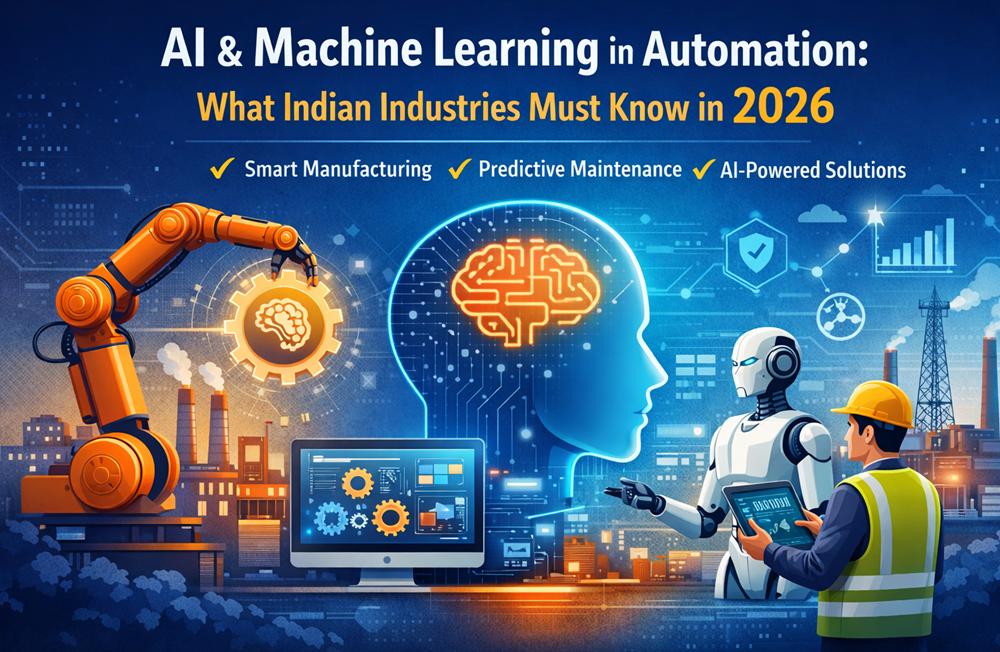
AI & Machine Learning in Automation: What Indian Industries Must Know in 2026
Indian industries are entering a new era of transformation. Automation has already changed how factories operate, but the next big shift is being driven by Artificial Intelligence (AI) and Machine Learning (ML). By 2026, AI-powered automation will no longer be optional—it will be a necessity for industries that want to remain competitive, efficient, and sustainable.
AI & Machine Learning in Automation: What Indian Industries Must Know in 2026 is not just a trend-based topic; it is a roadmap for the future of manufacturing, energy, oil & gas, utilities, and process industries across India.
Understanding AI and Machine Learning in Industrial Automation
AI refers to systems that can mimic human intelligence, such as learning, decision-making, and problem-solving. Machine Learning is a subset of AI that allows systems to learn from data and improve performance over time without being explicitly programmed.
In industrial automation, AI and ML are used to:
- Analyze large volumes of operational data
- Identify patterns and anomalies
- Predict failures and inefficiencies
- Optimize processes automatically
Unlike traditional automation, which follows fixed logic, AI-driven automation adapts and improves continuously.
Why AI and Machine Learning Matter for Indian Industries
Indian industries face increasing pressure from global competition, rising energy costs, skilled labor shortages, and strict environmental regulations. AI and ML directly address these challenges.
By 2026, industries that adopt AI-based automation will benefit from:
- Higher productivity with fewer resources
- Reduced downtime and maintenance costs
- Better product quality and consistency
- Improved energy efficiency
- Faster decision-making
This is why AI & Machine Learning in Automation: What Indian Industries Must Know in 2026 is a critical discussion for business leaders and plant managers.
Key Drivers Accelerating AI Adoption in India
Several factors are pushing Indian industries toward AI-powered automation:
- Industry 4.0 and Digital Transformation
Government initiatives like “Make in India” and “Digital India” are encouraging smart factories and digital operations.
- Availability of Industrial Data
Modern plants generate massive amounts of data from PLCs, SCADA, sensors, and IoT devices. AI turns this data into actionable insights.
- Cost Optimization Needs
AI helps reduce energy waste, rework, and unplanned shutdowns, leading to significant cost savings.
- Skilled Workforce Gap
AI systems support operators by automating complex analysis and reducing dependency on highly specialized manpower.
Role of AI in Smart Manufacturing
Smart manufacturing relies heavily on AI and ML to connect machines, systems, and people into one intelligent ecosystem.
AI enables:
- Real-time monitoring of production lines
- Automated quality inspection
- Dynamic scheduling and planning
- Self-optimizing processes
By 2026, most smart factories in India will use AI-based systems to improve overall equipment effectiveness (OEE).
Machine Learning for Predictive Maintenance
One of the most impactful uses of ML in automation is predictive maintenance.
Traditional maintenance methods are either reactive (fix after failure) or preventive (fixed schedules). Machine learning changes this approach by predicting failures before they happen.
Benefits include:
- Reduced unplanned downtime
- Longer equipment life
- Lower maintenance costs
- Improved safety
ML models analyze vibration, temperature, pressure, and historical failure data to identify early warning signs.
AI in Process Optimization and Control
AI-based control systems can automatically adjust parameters such as temperature, pressure, and flow rates to maintain optimal performance.
In industries like:
- Oil & gas
- Power generation
- Chemicals
- Cement and steel
AI-driven automation ensures stable operations even under changing conditions. This adaptive control is far more effective than traditional rule-based systems.
Quality Control Using AI and Vision Systems
AI-powered vision systems are transforming quality inspection in Indian manufacturing.
These systems:
- Detect defects in real time
- Identify micro-level variations
- Reduce human inspection errors
- Improve product consistency
By 2026, AI-based visual inspection will become standard in automotive, electronics, FMCG, and pharmaceutical industries.
AI and Energy Management in Automation
Energy efficiency is a major concern for Indian industries. AI helps optimize energy consumption by analyzing usage patterns and identifying inefficiencies.
AI-based energy management systems can:
- Optimize load distribution
- Reduce peak demand charges
- Improve fuel efficiency in thermal systems
- Support carbon footprint reduction
This directly supports sustainability and ESG goals.
AI Integration with PLC, SCADA, and DCS
AI does not replace traditional automation systems—it enhances them.
Modern automation architecture integrates:
- PLC for real-time control
- SCADA for monitoring and visualization
- DCS for complex process control
- AI/ML layers for analytics and optimization
This hybrid approach ensures reliability while enabling intelligence and flexibility.
Cybersecurity and Data Management Challenges
As AI systems rely heavily on data and connectivity, cybersecurity becomes critical.
Indian industries must focus on:
- Secure industrial networks
- Data access control
- Safe cloud and edge computing
- Compliance with cybersecurity standards
AI models are only as good as the data they receive, so data quality and security are essential.
Skills and Workforce Transformation
AI and ML will change job roles but not eliminate human involvement.
By 2026, industries will need:
- Automation engineers with AI knowledge
- Data analysts for industrial applications
- Operators trained to work with AI systems
Upskilling and reskilling will be key to successful AI adoption.
Industry-Specific Use Cases in India
Manufacturing
AI improves production planning, defect detection, and predictive maintenance.
Oil & Gas
AI enhances process safety, leak detection, and asset monitoring.
Power and Energy
AI optimizes generation, transmission, and energy consumption.
Utilities and Infrastructure
AI supports smart grids, water management, and waste processing.
Each sector benefits differently, but the core advantage is smarter decision-making.
What Indian Industries Must Prepare for by 2026
To fully benefit from AI-driven automation, Indian industries must:
- Upgrade legacy systems
- Invest in data infrastructure
- Choose scalable automation platforms
- Partner with experienced automation solution providers
- Focus on cybersecurity and compliance
Early adopters will gain a strong competitive advantage.
Future Outlook: AI-Driven Autonomous Factories
By 2026 and beyond, Indian industries will move toward semi-autonomous and autonomous factories.
These factories will:
- Self-monitor performance
- Predict and correct issues
- Optimize energy and resources automatically
- Respond quickly to market demands
AI & Machine Learning in Automation will be the foundation of this transformation.
Conclusion
AI and Machine Learning are redefining industrial automation in India. They enable smarter, safer, and more efficient operations while supporting sustainability and global competitiveness.
AI & Machine Learning in Automation: What Indian Industries Must Know in 2026 is not about future possibilities—it is about present preparation. Indian industries that invest in AI-driven automation today will lead tomorrow’s global manufacturing landscape.
By understanding the technology, preparing the workforce, and adopting a strategic approach, Indian industries can unlock the full potential of AI-powered automation and secure long-term growth.