
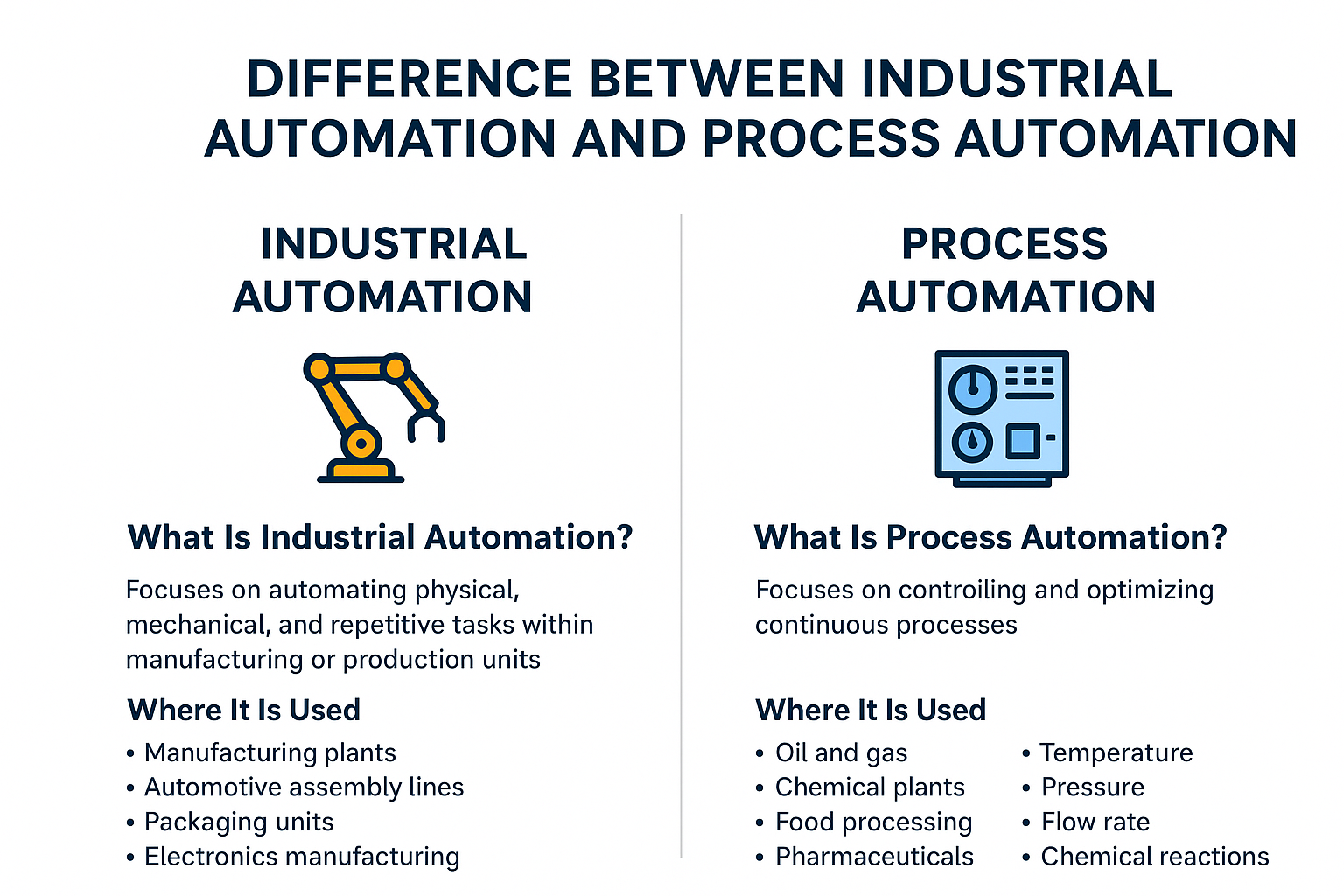
Difference Between Industrial Automation and Process Automation
In today’s rapidly evolving industrial world, businesses are constantly looking for ways to improve efficiency, reduce human errors, and enhance production quality. Automation has become a powerful solution for achieving these goals. However, many people get confused between two commonly used terms—industrial automation and process automation. While both aim to optimize operations, they work in different ways and serve different purposes.
Understanding the difference between these two types of automation is essential for companies planning to upgrade their systems or integrate new technologies. Partnering with an experienced Industrial Automation Company Noida can help businesses choose the right automation solution based on their industry needs.
This article explains what industrial and process automation mean, how they differ, and why each is important for modern industries.
What Is Industrial Automation?
Industrial automation involves using machines, control systems, sensors, robotics, and software to perform manufacturing tasks without human intervention. It is commonly used in industries where repetitive, high-speed, and precision-based tasks are required.
Key Features of Industrial Automation
- Automation of physical tasks such as assembly, packing, welding, cutting, and inspection.
- Use of advanced technologies like PLCs (Programmable Logic Controllers), SCADA systems, robotics, and AI-driven systems.
- Improved productivity due to faster cycle times and continuous operations.
- Reduced manual labor and minimal chances of human errors.
Industrial automation is widely used in automotive manufacturing, electronics production, FMCG (Fast-Moving Consumer Goods), machine assembly, and metal fabrication industries.
What Is Process Automation?
Process automation refers to automating continuous processes involving chemicals, liquids, gases, or energy flows. Instead of physical assembly work, it focuses on controlling and optimizing process variables such as temperature, pressure, flow, and chemical reactions.
Key Features of Process Automation
- Automation of continuous processes rather than physical tasks.
- Use of control systems like DCS (Distributed Control Systems) and advanced sensors.
- Improved accuracy and safety for chemical and energy-based operations.
- Monitoring and regulating variables in real time to maintain consistency.
Process automation is used in industries such as oil and gas, pharmaceuticals, chemical plants, power plants, food processing, and water treatment facilities.
Industrial Automation vs. Process Automation: Key Differences
Although both automate operations, their goals, methods, and applications differ. Here are the major distinctions:
- Type of Work Automated
Industrial Automation:
Focuses on mechanical and physical tasks, such as assembling car parts, welding metal components, or packaging products.
Process Automation:
Focuses on continuous and chemical processes, such as heating fluids, controlling chemical reactions, or managing power distribution.
- Nature of Operations
Industrial Automation handles:
- Discrete manufacturing
- Step-by-step operations
- Tasks that produce individual items
Process Automation handles:
- Continuous operations
- Flows of liquids, gases, or energy
- Tasks that require real-time variable control
- Technologies Used
Industrial Automation:
- PLC systems
- Robotics
- Sensors and actuators
- Machine vision systems
- SCADA
Process Automation:
- DCS systems
- Advanced instrumentation
- Distributed sensor networks
- Process controllers
- SCADA (for monitoring)
- Desired Outcome
Industrial Automation aims for:
- Faster cycle time
- High precision
- Repeatability
- Reduction in manual labor
Process Automation aims for:
- Accurate control of process variables
- Safety in hazardous environments
- Consistent output quality
- Waste reduction
- Industries Using Automation
Industrial Automation:
Automotive, heavy machinery, electrical appliances, packaging, and electronics.
Process Automation:
Oil refining, pharmaceuticals, chemicals, water treatment, food processing, power generation.
- Level of Human Involvement
Industrial Automation:
May require skilled operators for machine setup and maintenance.
Process Automation:
Minimal human involvement as systems run continuously with automatic monitoring and adjustments.
Why Understanding the Difference Matters
Choosing the wrong type of automation can lead to poor results, unnecessary costs, and system inefficiencies. For example:
- A car manufacturing unit needs industrial automation because assembly operations are discrete and mechanical.
- A chemical plant requires process automation to regulate mixture temperatures, chemical flows, and pressure levels.
A professional Industrial Automation Company Noida can help businesses assess their operational needs and select the right automation strategy.
How Automation Benefits Modern Industries
Whether industrial or process automation, both offer a range of advantages:
✔ Increased Productivity
Machines operate faster and longer than humans, resulting in higher output.
✔ Improved Accuracy
Automation ensures precise operations, reducing errors and defects.
✔ Cost Savings
Although the initial investment is high, long-term operational costs decrease significantly.
✔ Better Safety
Automation removes humans from hazardous tasks and environments.
✔ Quality Consistency
Automation maintains uniform quality throughout the production cycle.
✔ Real-Time Monitoring
Advanced control systems track performance and detect issues early.
How an Industrial Automation Company Noida Can Help
A reliable automation partner provides:
- System design and consultation
- PLC/SCADA integration
- Robotics implementation
- Process monitoring solutions
- Custom automation solutions
- Installation and after-sales support
Working with a trusted Industrial Automation Company Noida ensures your business receives tailored automation solutions that enhance overall efficiency and reduce downtime.
Future Trends in Automation
Automation is evolving rapidly with new technologies such as:
- Artificial Intelligence (AI)
- Machine Learning (ML)
- Industrial Internet of Things (IIoT)
- Robotic Process Automation (RPA)
- Digital Twins
- 5G-enabled automation
These innovations are making automation smarter, more predictive, and more efficient.
Conclusion
Both industrial automation and process automation play crucial roles in modern industry but serve different purposes. Industrial automation focuses on mechanical tasks and manufacturing operations, while process automation controls continuous processes involving energy, liquids, and chemicals.
For any business planning to upgrade or automate operations, understanding these differences is the first step. Partnering with a professional Industrial Automation Company Noida can help you choose the right automation approach and adopt cutting-edge technology that improves productivity, reduces costs, and enhances long-term performance.
Top FAQs Related to Industrial & Process Automation
- What is the main difference between industrial automation and process automation?
Industrial automation focuses on controlling machinery, equipment, and production lines in manufacturing industries.
Process automation, on the other hand, focuses on controlling chemical, continuous, or batch processes such as oil refining, food processing, and pharmaceuticals.
- How does an Industrial Automation Company Noida help in implementing automation?
An Industrial Automation Company Noida provides end-to-end solutions such as PLC programming, SCADA systems, robotics integration, sensor setup, and maintenance services to ensure plants operate efficiently and safely.
- Which industries use industrial automation the most?
Industries using industrial automation include automotive, electronics, packaging, textiles, and heavy machinery manufacturing. These industries rely on robotics and machine control for speed and precision.
- Which industries rely on process automation?
Process automation is widely used in chemical plants, pharmaceuticals, oil & gas, water treatment, food & beverage production, and power generation, where continuous monitoring and control are required.
- Are industrial automation and process automation interchangeable?
No. While both aim to improve efficiency, they are used in different settings. Industrial automation is machine-focused (discrete manufacturing), while process automation is flow-focused (continuous/batch processes).
- What technologies are used in industrial automation?
Key technologies include:
- PLC (Programmable Logic Controller)
- SCADA systems
- Robotics
- HMI (Human Machine Interface)
- CNC machines
- IoT-enabled industrial sensors
- What technologies are used in process automation?
Common technologies include:
- DCS (Distributed Control Systems)
- SCADA for monitoring
- Control valves and actuators
- Batch control systems
- Advanced process controllers (APC)
- Which is more expensive: industrial automation or process automation?
Costs vary by system size and industry, but generally, process automation systems (like DCS) tend to be more expensive due to complex continuous operations and safety systems.
- Can automation help reduce operational costs?
Yes. Both industrial and process automation help reduce labor costs, minimize errors, improve production speed, increase safety, and optimize resource usage.
- How do I choose between industrial automation and process automation for my business?
It depends on your industry:
- If you manufacture physical products using machinery → Industrial automation
- If you manage continuous processes like chemicals or liquids → Process automation
Consulting an Industrial Automation Company Noida can help determine the right system for your needs.
- Does automation require regular maintenance?
Yes. Automated systems like PLCs, sensors, and robotics require periodic inspection, calibration, and software updates to ensure long-term efficiency and prevent breakdowns.
- Can small industries also adopt automation?
Absolutely. Automation is not limited to large factories. Small and medium industries can implement cost-effective PLC-based systems, sensors, and basic robotics to improve productivity.