
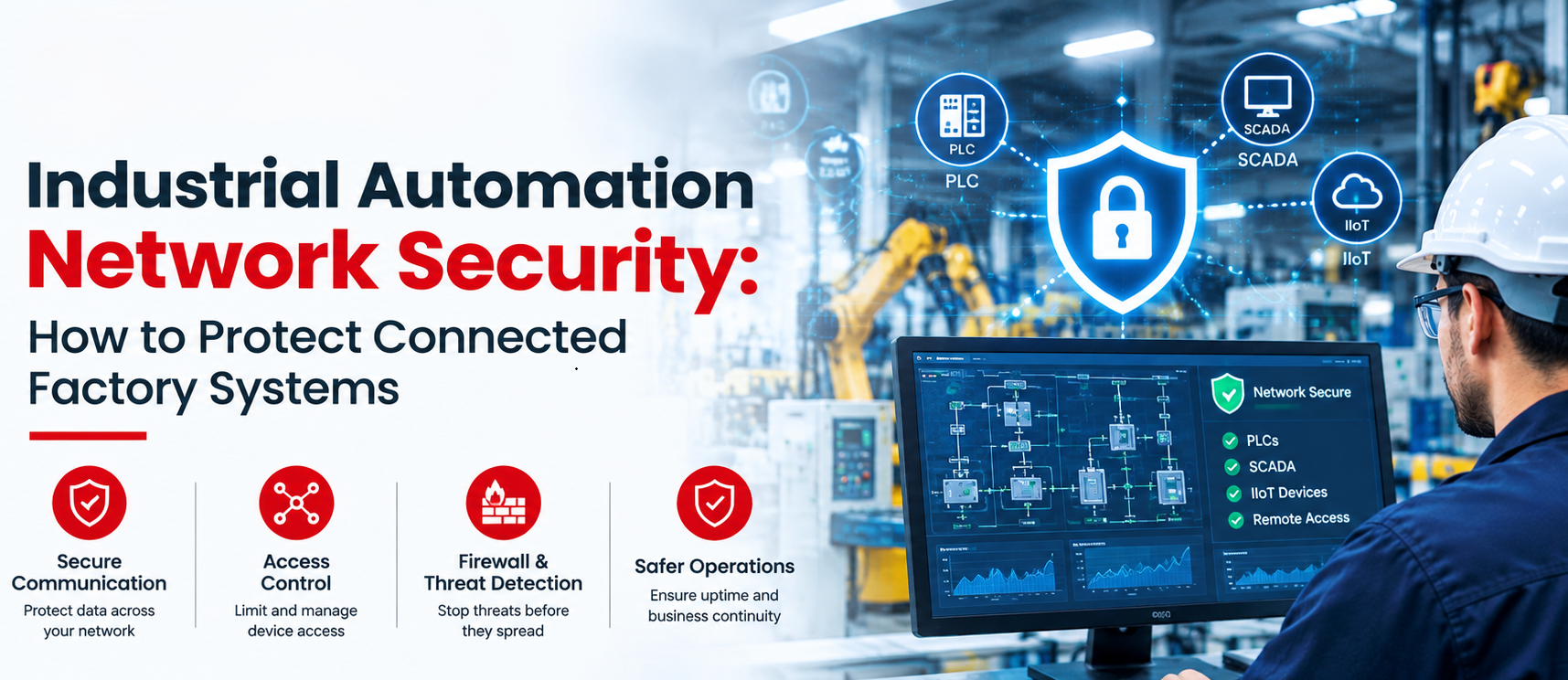
Industrial Automation Network Security: How to Protect Connected Factory Systems
Factories are becoming more connected. PLCs, SCADA systems, sensors, industrial computers and other automation devices are now connected through industrial networks. IIoT systems are also helping factories collect production data and monitor machines in real time.
This connectivity can help improve production and monitoring. But it also means that industrial systems need proper network security.
A problem in an industrial network can affect machine communication, production monitoring and in some cases the operation of the plant. This is why network security should be considered while designing or upgrading an industrial automation system.
For manufacturers using PLC, SCADA, DCS, IIoT and remote monitoring systems, industrial network security should be a part of the overall automation plan.
What Is Industrial Automation Network Security?
Industrial automation network security means protecting the communication networks and connected systems used to control and monitor industrial processes.
These systems can include:
- PLCs
- SCADA systems
- DCS systems
- HMIs
- Industrial computers
- Sensors
- Industrial switches
- Engineering workstations
- Servers
- Remote access systems
- IIoT devices
- Data collection systems
The main purpose is to protect these systems from unauthorised access, unwanted network activity, data loss and other security problems.
The security approach should also make sure that production systems remain available and reliable.
Why Industrial Networks Need Security
Older industrial systems were often designed mainly for reliability and continuous operation. Today many of these systems are connected with plant networks and IT systems.
IIoT and Industry 4.0 can create even more connections between machines and digital platforms.
For example, a factory may have a setup where:
Sensors → PLC → SCADA → Industrial Network → IIoT Platform → Cloud
Each connection needs to be planned properly.
If access to these systems is not controlled, the plant may face unnecessary security risks.
This does not mean that every connected factory will face an attack. It means that connected systems should be designed with suitable protection from the beginning.
Common Industrial Network Security Risks
Industrial plants can face different types of security risks.
Unauthorised Access
If access to an automation system is not properly controlled, an unauthorised person may gain access to machines or industrial applications.
User accounts, passwords and access permissions should be managed properly.
Unsafe Remote Access
Remote access can be useful for technical support and monitoring.
However, remote access should be designed carefully. Uncontrolled remote access can create a security risk for the industrial network.
Malware and Ransomware
Industrial computers and servers can be affected by malware or ransomware.
If an infected system is connected to the production network, the problem may spread to other systems depending on the network design.
Outdated Software
Old operating systems and software may have security weaknesses.
Many industrial systems remain in operation for years, so software and security updates need to be planned carefully.
Poor Network Design
If all systems are connected to the same network without proper separation, a problem in one area may affect other systems.
Network segmentation can help reduce this risk.
Industrial Network Segmentation
Network segmentation means dividing a network into separate sections based on their purpose.
For example, a factory may have separate areas for:
- Office IT systems
- Production systems
- SCADA systems
- Engineering systems
- IIoT systems
- Remote access
This can reduce unnecessary communication between different parts of the network.
A simple architecture can look like:
Corporate IT Network
↓
Industrial DMZ
↓
SCADA Network
↓
PLC and Machine Network
The actual network design should be based on the plant requirements and security assessment.
Why Firewalls Are Important
Firewalls can help control network communication between different network areas.
For example, a firewall can be used between an office network and an industrial network.
Instead of allowing all traffic, specific communication can be allowed based on the system requirements.
This can reduce unnecessary access.
Firewall rules should be planned carefully because blocking the wrong communication can affect industrial operations.
Secure Remote Access for Industrial Systems
Remote access is becoming common in industrial automation.
Engineers may need remote access for:
- System diagnosis
- Software support
- Maintenance
- Monitoring
- Troubleshooting
- Technical assistance
Sofcon’s Industry 4.0 and IIoT solutions include remote access along with network monitoring and security. (Sofcon Automation)
Remote access should be provided only to authorised users.
Some important practices include:
- User authentication
- Limited access
- Access based on user role
- Secure communication
- Session monitoring
- Access logs
- Removing unused accounts
Remote access should also be disabled when it is not required.
Protecting PLC Systems
PLCs are an important part of industrial automation.
They control machines and processes based on programmed logic.
Because PLCs are connected to industrial networks, access to PLC programming and communication should be controlled.
Important practices can include:
- Restricting programming access
- Using authorised engineering workstations
- Managing user permissions
- Keeping backups of PLC programs
- Recording important changes
- Limiting unnecessary network communication
PLC security should be planned without affecting the normal control process.
Protecting SCADA Systems
SCADA systems collect and display industrial process data.
They may also provide operators with control functions.
A SCADA system can therefore be an important part of the industrial network.
Security measures can include:
- Controlled user access
- Strong authentication
- Network segmentation
- Secure remote access
- Regular backup
- System monitoring
- Controlled software updates
SCADA servers and operator stations should be protected according to their role in the automation system.
Security for DCS Systems
DCS systems are widely used in process industries such as chemicals, power, oil and gas and other continuous production applications.
A DCS can manage many control loops and process operations.
Because these systems are important for plant operation, their network architecture should include suitable security controls.
This can include network separation, controlled access, system monitoring and proper backup procedures.
The security plan should be developed according to the DCS architecture and plant requirements.
IIoT and Industrial Network Security
IIoT connects industrial equipment with data platforms and monitoring systems.
This can provide useful information about production and machine performance.
At the same time, every new connection should be reviewed from a security point of view.
For example, before connecting a PLC to an IIoT platform, engineers should understand:
- What data needs to be shared
- Where the data will go
- Who can access it
- How the communication is protected
- What happens if communication is lost
- How the device will be managed
This helps keep the IIoT project connected without creating unnecessary network access.
Protecting Industrial Data
Manufacturing systems generate different types of data.
This may include:
- Production data
- Machine data
- Energy data
- Process values
- Maintenance information
- Quality information
- Alarm history
Not every user needs access to all this information.
Access should be given according to the user’s role.
For example, an operator may need access to production monitoring while an engineer may need additional access for system maintenance.
This approach can reduce unnecessary access to industrial systems.
User Access Management
User accounts are an important part of industrial network security.
Factories should know who has access to their automation systems.
Unused accounts should be removed.
Employees who change roles should have their access updated.
Temporary access should also have a clear purpose and time period.
A simple user access structure can include:
Operator
Basic monitoring and control access.
Engineer
Additional system configuration and troubleshooting access.
Administrator
Higher level system management access.
The exact roles depend on the plant and automation system.
Backups for Industrial Automation Systems
Security is not only about preventing problems.
Factories should also be prepared to recover systems if something goes wrong.
Regular backups can help protect important information such as:
- PLC programs
- SCADA configuration
- HMI projects
- DCS configuration
- Server data
- System settings
- Engineering files
Backups should be stored safely and tested from time to time.
A backup is useful only when the factory can actually use it to restore the required system.
Monitoring Industrial Network Activity
Network monitoring can help identify unusual activity.
A factory can monitor important communication and system events to understand what is happening on the network.
Monitoring can help identify:
- Unusual communication
- Repeated login failures
- Unexpected device activity
- Network problems
- System alarms
- Communication failures
Sofcon lists network monitoring and security as part of its Industry 4.0 and IIoT service offering. (Sofcon Automation)
Industrial Cybersecurity Standards
Industrial cybersecurity is a specialised area.
IEC 62443 is one important standard family related to the security of industrial automation and control systems.
It provides guidance for industrial cybersecurity across different areas of automation systems.
Sofcon’s existing content also discusses IEC 62443 along with other automation standards such as IEC 61131, IEC 61508 and IEC 62061. (Sofcon Automation)
Companies should select standards and security practices based on their industry, plant requirements and risk assessment.
Network Security During Industry 4.0 Projects
Security should not be added only after an Industry 4.0 system has been installed.
It should be considered during the planning stage.
For example, when a factory wants to add an IIoT platform, the project team should decide:
- Which machines will be connected
- Which data will be collected
- Which network will be used
- Which users need access
- How remote access will work
- How data will be protected
- How devices will be monitored
- How the system will be maintained
This approach can help avoid unnecessary changes later.
Industrial Network Security for Existing Factories
A factory does not always need to replace its complete automation system to improve network security.
Many plants have older PLCs, SCADA systems and industrial computers that are still working properly.
The first step can be an assessment of the existing network.
The assessment can check:
- Connected devices
- Network structure
- Communication protocols
- User accounts
- Remote access
- Firewall settings
- Software versions
- Backup process
- Data flow
After this assessment, security improvements can be planned according to the actual risks and requirements.
How to Improve Industrial Network Security
Manufacturers can follow a step by step approach.
Step 1: Identify Connected Systems
Make a list of PLCs, SCADA servers, HMIs, industrial PCs, switches, gateways and other connected devices.
Step 2: Understand Data Flow
Check how data moves between machines, control systems, IT networks and IIoT platforms.
Step 3: Control User Access
Give users only the access they need for their work.
Step 4: Separate Network Areas
Use suitable network segmentation to separate production systems from office and other networks.
Step 5: Secure Remote Access
Allow remote access only through controlled and secure methods.
Step 6: Monitor Network Activity
Monitor important communication and system events.
Step 7: Maintain Backups
Keep updated backups of important automation programs and system configurations.
Step 8: Review Security Regularly
Industrial networks change over time. New machines and systems are added. Security should therefore be reviewed regularly.
Why Security Should Not Affect Plant Availability
Industrial automation systems have a different requirement from normal office IT systems.
A factory may need a control system to operate continuously.
A security change that causes an unexpected machine stop can create a production problem.
Therefore, security improvements should be planned and tested properly before they are introduced into a live production environment.
Changes should be carried out with proper understanding of the automation process.
Industrial Automation and Secure Connectivity
Modern factories need connectivity for better monitoring and data use.
The answer is not to disconnect every system from the network.
Instead, manufacturers should create controlled and secure connectivity.
PLC, SCADA, DCS, IIoT and remote monitoring systems can be connected according to the plant’s operational and security requirements.
This allows manufacturers to use digital technologies while keeping network access under control.
How Sofcon Can Support Connected Industrial Systems
Sofcon provides industrial automation and Industry 4.0 and IIoT solutions. Its services include factory floor automation, remote access, network monitoring and security, secure cloud IoT platforms, custom edge solutions and dashboards. Its IIoT solutions can collect data from SCADA, DCS systems, OPC UA servers and PLCs for real time asset monitoring. (Sofcon Automation)
For companies planning an automation or digitalisation project, network security should be considered along with system integration and data monitoring.
Sofcon’s industrial automation services cover areas such as PLC, SCADA, DCS and other automation solutions. (Sofcon Automation)
Conclusion
Industrial network security is becoming more important as factories connect machines, control systems and digital platforms.
PLC, SCADA, DCS and IIoT systems can provide better production visibility and automation. But these systems also need controlled access, proper network design and suitable security measures.
Manufacturers can start by understanding their existing network, controlling user access, securing remote connections, separating network areas, monitoring activity and keeping proper system backups.
For new Industry 4.0 projects, security should be included from the planning stage itself.
A secure industrial network can help manufacturers use connected automation systems while maintaining the reliability and availability needed for production.