
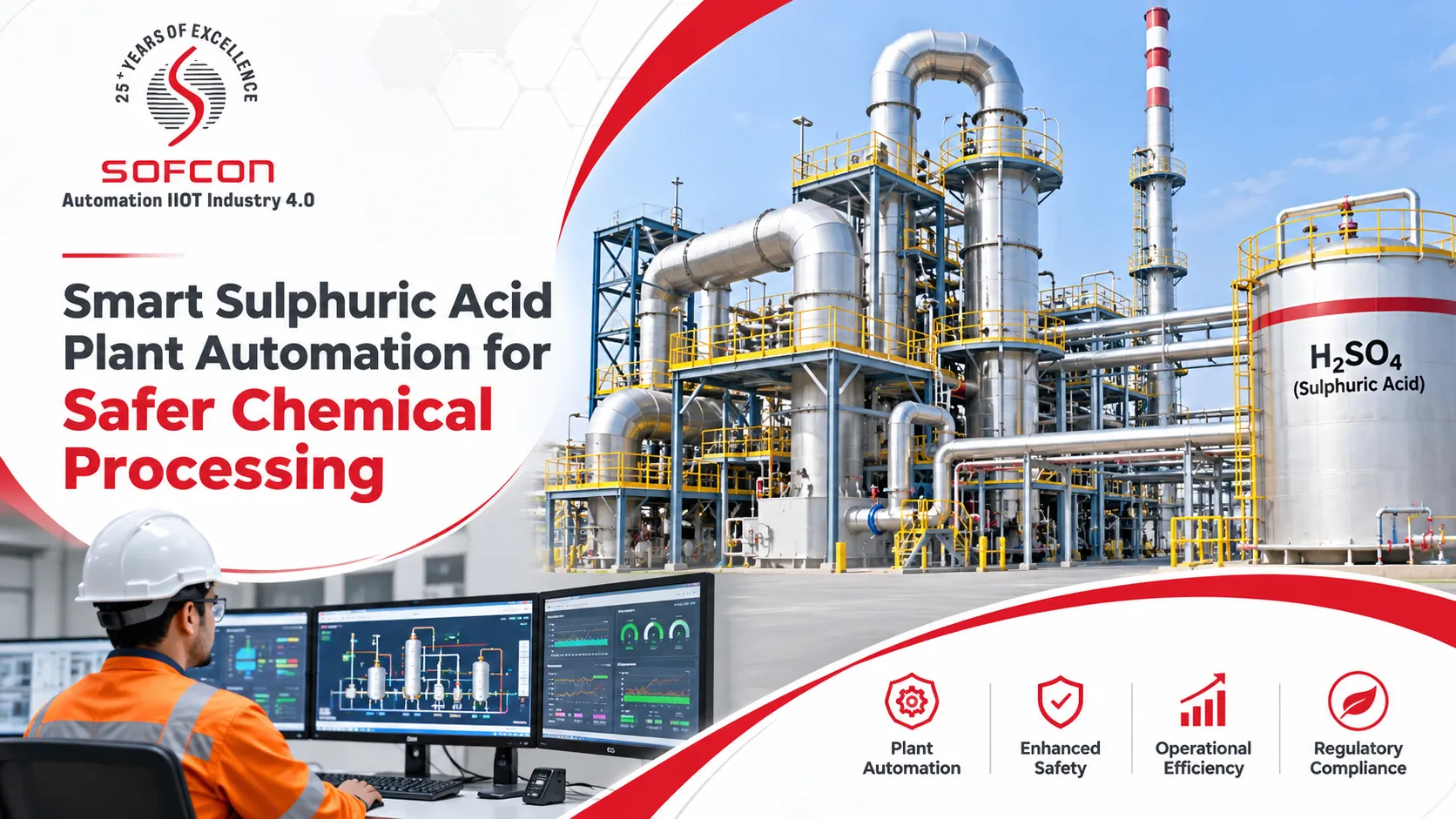
Smart Sulphuric Acid Plant Automation for Safer Chemical Processing
Sulphuric acid is one of the most important industrial chemicals, widely used in fertilizer manufacturing, petroleum refining, metal processing, chemical production, and wastewater treatment. Its production involves high-temperature chemical reactions, corrosive substances, hazardous gases, and energy-intensive operations that require accurate monitoring and control.
For chemical manufacturers, maintaining consistent production quality while ensuring worker safety, equipment reliability, and environmental compliance is a major operational challenge.
Sulphuric Acid Plant Automation helps address these challenges by integrating advanced control technologies such as Programmable Logic Controllers (PLC), Distributed Control Systems (DCS), Supervisory Control and Data Acquisition (SCADA), and Industrial Internet of Things (IIoT).
These technologies enable continuous process monitoring, automated equipment control, alarm management, and data-driven operational decisions.
With properly engineered automation solutions, sulphuric acid manufacturers can improve process stability, reduce unnecessary downtime, optimize energy utilization, and strengthen operational safety.
What Is Sulphuric Acid Plant Automation?
Sulphuric Acid Plant Automation is the use of industrial control systems, intelligent instrumentation, and monitoring technologies to regulate and supervise the production of sulphuric acid (H₂SO₄).
It involves automating critical production stages, including sulphur combustion, gas cooling, catalytic conversion, absorption, acid circulation, and heat recovery.
A modern sulphuric acid plant automation system typically includes:
- PLC Systems: Control equipment sequences, pumps, motors, valves, and auxiliary machinery.
- DCS Systems: Manage interconnected chemical processes, continuous control loops, and plant operations.
- SCADA Systems: Provide centralized monitoring, alarms, process trends, and operational data.
- Field Instrumentation: Measures temperature, pressure, flow, level, acid concentration, and gas composition.
- Safety Instrumented Systems (SIS): Perform designated protective functions independently of basic process control where required.
- IIoT Platforms: Support equipment monitoring, historical data analysis, and industrial performance dashboards.
Together, these technologies help chemical manufacturers maintain stable operating conditions and improve visibility across the production process.
Understanding the Sulphuric Acid Manufacturing Process
Most modern sulphur-burning sulphuric acid plants use the contact process, often incorporating double-contact double-absorption (DCDA) technology.
The process involves converting sulphur into sulphur dioxide (SO₂), oxidizing it to sulphur trioxide (SO₃), and absorbing SO₃ into concentrated sulphuric acid.
1. Sulphur Burning
Elemental sulphur is combusted with air to produce sulphur dioxide.
Chemical reaction:
S + O₂ → SO₂
The process releases heat and requires controlled sulphur and air feed rates.
2. Gas Cooling and Heat Recovery
Hot process gases pass through heat recovery equipment, such as waste heat boilers and heat exchangers.
Recovering thermal energy can generate steam for plant operations or other suitable applications.
3. Catalytic Conversion
Sulphur dioxide is converted into sulphur trioxide using a catalyst, commonly based on vanadium pentoxide.
Chemical reaction:
2SO₂ + O₂ ⇌ 2SO₃
Temperature, gas composition, catalyst condition, and gas flow influence conversion performance.
4. Sulphur Trioxide Absorption
Sulphur trioxide is absorbed into circulating concentrated sulphuric acid under controlled conditions.
This produces additional sulphuric acid while avoiding the uncontrolled direct hydration of SO₃, which can generate fine acid mist.
5. Acid Concentration and Storage
The finished acid is maintained at the required concentration and transferred through suitable cooling, circulation, and storage systems.
Every stage requires coordinated industrial process automation to maintain production efficiency, equipment protection, and safe operating conditions.
Why Is Smart Automation Essential in Sulphuric Acid Plants?
Sulphuric acid manufacturing requires continuous operations with tightly controlled process parameters.
Manual monitoring alone may not provide sufficient visibility into rapidly changing temperatures, gas concentrations, equipment faults, or abnormal operating conditions.
Smart automation enables operators to monitor multiple production stages from a centralized control system while maintaining automatic regulation of critical process variables.
Key Operational Challenges
- Maintaining stable sulphur combustion conditions
- Controlling catalytic converter temperatures
- Monitoring SO₂ and SO₃ concentrations
- Regulating acid circulation and concentration
- Preventing overheating and equipment damage
- Detecting abnormal gas emissions
- Managing corrosion and acid leakage risks
- Improving energy recovery efficiency
- Reducing unexpected production interruptions
A well-designed Sulphuric Acid Plant Control System helps chemical manufacturers manage these challenges through reliable instrumentation, control logic, alarms, and engineered protective functions.
Key Applications of Automation in Sulphuric Acid Manufacturing
1. Automated Sulphur Burning and Furnace Control
The sulphur-burning section is a critical part of the acid production process.
Inconsistent sulphur feed or combustion air conditions can affect furnace performance and the composition of process gases entering downstream equipment.
Automated furnace control systems can monitor and regulate:
- Molten sulphur feed flow
- Combustion air flow
- Furnace temperature
- Combustion air pressure
- Air-to-sulphur ratio
- Burner and auxiliary equipment status
- Process alarms and operating conditions
These controls support stable sulphur dioxide generation and help maintain consistent downstream processing conditions.
2. Catalytic Converter Temperature Control
The catalytic converter plays a central role in converting sulphur dioxide into sulphur trioxide.
Catalyst performance depends on maintaining suitable operating temperatures and gas conditions.
DCS and PLC-based automation can provide:
- Converter inlet temperature monitoring
- Individual catalyst bed temperature monitoring
- Gas flow and composition measurements
- Heat exchanger and gas cooling control
- Temperature deviation alarms
- Historical converter performance trends
Accurate temperature monitoring helps operators identify abnormal process behavior and maintain efficient catalytic conversion.
3. Automated Absorption Tower Control
The absorption stage requires effective contact between process gases and circulating sulphuric acid.
Poor control of acid temperature, concentration, or circulation may reduce absorption performance and contribute to operational problems.
Automation systems can monitor:
- Acid circulation flow
- Acid temperature and concentration
- Absorption tower pressure drop
- Circulation pump performance
- Acid tank levels
- Cooling system conditions
- Mist eliminator differential pressure
These measurements support stable acid absorption, reliable equipment operation, and improved product consistency.
4. Heat Recovery and Steam System Automation
Sulphuric acid production involves highly exothermic chemical reactions that release substantial thermal energy.
When suitable heat recovery systems are installed, the recovered energy can be used to generate steam and support other industrial processes.
Automation can help manage:
- Waste heat boiler operating conditions
- Steam pressure and temperature
- Boiler drum water level
- Feedwater flow
- Heat exchanger performance
- Steam generation trends
- Equipment alarms and protection signals
By improving the monitoring and regulation of heat recovery equipment, automation can support energy efficiency and more stable steam production.
5. Acid Storage and Transfer Automation
Sulphuric acid storage and transfer operations require careful monitoring because of the material’s corrosive properties.
Automated monitoring and control can include:
- Storage tank level measurement
- High-level and overfill alarms
- Transfer pump control
- Flow measurement
- Valve status monitoring
- Leak detection integration
- Transfer operation event logging
These systems support controlled material handling and reduce reliance on repetitive manual monitoring.
How Sulphuric Acid Plant Automation Improves Industrial Safety
Safety is a fundamental requirement in sulphuric acid manufacturing.
The production process involves sulphur dioxide, sulphur trioxide, concentrated sulphuric acid, and high-temperature equipment, all of which require appropriate engineering controls and operating procedures.
Smart automation contributes to safer chemical processing through continuous monitoring, early warning systems, and protective control functions.
Real-Time Hazard Monitoring
Industrial sensors and gas detection systems can identify abnormal concentrations, leaks, and process deviations.
Operators receive alarms that help them recognize hazardous conditions and follow established response procedures.
Safety Interlocks and Emergency Shutdown Systems
Safety interlocks can initiate predefined protective actions when critical operating parameters exceed established limits.
For example, appropriately designed protective functions may respond to loss of essential circulation, unsafe equipment temperatures, or hazardous pressure conditions.
Safety-critical functions must be selected through a formal hazard and risk assessment and validated for the required integrity.
Reduced Manual Exposure
Remote monitoring and automated equipment operation can reduce the frequency of certain manual activities near hot equipment and corrosive chemicals.
Centralized Alarm Management
SCADA and DCS interfaces help operators monitor active alarms, acknowledge events, and review process history.
Effective alarm management also requires rationalized alarm priorities and clear operating procedures.
Process Safety Documentation
Automation systems can provide time-stamped operating records, alarms, and event histories that support incident investigations and safety reviews.
However, automation does not replace personnel training, mechanical integrity programs, emergency planning, or regulatory compliance procedures.
PLC, DCS and SCADA: Which System Is Best for a Sulphuric Acid Plant?
The right automation architecture depends on plant capacity, process complexity, existing equipment, and operational requirements.
Each technology serves a different purpose.
| Technology | Main Function | Typical Sulphuric Acid Plant Application |
| PLC | Equipment and sequential control | Pumps, motors, valves, and auxiliary systems |
| DCS | Continuous and coordinated process control | Furnace, converter, absorber, and heat recovery control |
| SCADA | Monitoring and supervisory operations | Process dashboards, alarms, and historical trends |
| SIS / Safety PLC | Independent safety functions where required | Safety interlocks and emergency shutdown |
| IIoT | Industrial data acquisition and analytics | Asset monitoring, energy analytics, and maintenance insights |
For larger continuous-process plants, a DCS is often suitable for coordinating multiple process control loops.
PLCs may be used for equipment packages and auxiliary operations, while SCADA provides centralized supervisory capabilities.
The most effective solution is not necessarily one technology alone, but a properly integrated control architecture tailored to the plant.
Reducing SO₂ Emissions Through Smart Process Monitoring
Environmental performance is an important consideration in sulphuric acid manufacturing.
Sulphur dioxide emissions can occur when SO₂ conversion is incomplete. Sulphur trioxide and sulphuric acid mist also require effective management.
Automation helps operators monitor process conditions that influence emissions performance.
Automated Gas Monitoring
Suitable gas analyzers can measure sulphur dioxide and other relevant gas parameters at designated locations.
Converter Performance Monitoring
Tracking catalyst bed temperatures, gas composition, and process flow helps identify conditions that may reduce conversion efficiency.
Acid Mist Monitoring and Control
Automated monitoring of absorption conditions, mist eliminator pressure drop, and associated equipment supports proper operation of the emission control system.
Emissions Data Collection
Industrial monitoring systems can integrate data from applicable continuous emissions monitoring systems (CEMS), where installed or required.
This provides organized records for operational review and environmental reporting.
Automation supports emissions control but cannot independently guarantee compliance. Actual emissions depend on plant design, conversion efficiency, absorption performance, equipment condition, and the effectiveness of installed emission control technologies.
Improving Energy Efficiency in Sulphuric Acid Plants
Energy management is a major opportunity for process improvement in sulphuric acid manufacturing.
The production process releases significant heat, making effective heat recovery an important operational consideration.
Smart automation can support energy optimization through several applications.
Waste Heat Recovery Monitoring
Automated systems track thermal conditions in waste heat boilers, economizers, and heat exchangers.
This allows operators to evaluate heat recovery performance and investigate deviations.
Steam Generation Optimization
Steam pressure, temperature, and feedwater control help maintain reliable steam system operation.
Pump and Motor Efficiency
Variable Frequency Drives (VFDs) can be applied to suitable variable-load equipment to improve speed control and reduce unnecessary electrical consumption.
Production and Energy Dashboards
Integrated dashboards provide visibility into:
- Electricity consumption
- Steam generation
- Fuel or utility consumption
- Acid production rates
- Energy consumption per tonne of acid
- Heat recovery system performance
The data helps engineering teams identify inefficient operating conditions and prioritize improvement projects.
Industry 4.0 and IIoT in Sulphuric Acid Plant Automation
Modern sulphuric acid facilities are increasingly able to use connected data systems to support operational decisions.
Industry 4.0 and IIoT technologies extend traditional automation by connecting process equipment, instrumentation, control systems, and analytics platforms.
Real-Time Process Dashboards
Operators and plant managers can monitor key performance indicators through centralized digital interfaces.
Predictive Maintenance
Vibration, temperature, current, and equipment operating data can help identify developing problems in suitable pumps, blowers, motors, and other assets.
Advanced Process Analytics
Historical data can support analysis of process trends, catalyst performance, equipment availability, and energy utilization.
Centralized Data Integration
Industrial communication technologies, including OPC UA where compatible, can support secure data exchange between plant control systems and approved monitoring platforms.
Industrial Cybersecurity
Connected plants require secure system architecture, network segmentation, access controls, backup procedures, and monitored remote connections.
Digital integration should be implemented without compromising the independence or reliability of safety-critical systems.
Essential KPIs for Sulphuric Acid Plant Performance
Monitoring the right performance indicators helps manufacturers evaluate process stability, production efficiency, and maintenance effectiveness.
| Key Performance Indicator | What It Measures |
| SO₂ conversion efficiency (%) | Performance of catalytic conversion |
| Acid production (tonnes/day) | Manufacturing output |
| Sulphur consumption per tonne of acid | Raw material utilization |
| Converter temperature trends | Catalyst operating conditions |
| Acid concentration (%) | Product and circulation quality |
| Steam generation per tonne of acid | Heat recovery performance |
| Plant availability (%) | Operational reliability |
| Unplanned downtime (hours) | Production interruptions |
| SO₂ emissions | Environmental performance |
| Acid mist emissions | Absorption and emissions control performance |
| Specific energy consumption | Energy efficiency |
These indicators should be measured using consistent definitions and appropriate monitoring equipment.
How to Upgrade an Existing Sulphuric Acid Plant with Automation
Existing sulphuric acid plants may operate with aging instrumentation, standalone controllers, or limited process monitoring capabilities.
A phased automation upgrade can improve operational visibility without necessarily replacing the entire production infrastructure.
Step 1: Assess Existing Control Systems
Review current PLC, DCS, SCADA, instrumentation, electrical equipment, and network infrastructure.
Step 2: Identify Operational Gaps
Determine which areas require improved control, reliability, alarm management, emissions monitoring, or equipment data collection.
Step 3: Design the Automation Architecture
Develop a suitable architecture that addresses process control, safety system independence, industrial cybersecurity, and future expansion.
Step 4: Integrate Field Instrumentation
Connect compatible sensors, analyzers, actuators, motor controls, and industrial equipment.
Step 5: Perform Testing and Commissioning
Conduct appropriate Factory Acceptance Testing (FAT), Site Acceptance Testing (SAT), loop testing, functional verification, and safety validation.
Step 6: Train Plant Personnel
Provide operator and maintenance training covering the new control systems, operating procedures, alarms, and troubleshooting.
Step 7: Evaluate Operational Performance
Monitor process KPIs and identify opportunities for continuous improvement.
All significant modifications should be evaluated through the plant’s formal management-of-change and process safety procedures.
Why Choose Sofcon Systems for Sulphuric Acid Plant Automation?
Choosing a capable automation partner is important when modernizing complex chemical manufacturing facilities.
Sofcon Systems is an established industrial automation and engineering solutions provider offering expertise in control systems, instrumentation, industrial digitalization, and system integration.
As an experienced Industrial Automation Company India, Sofcon Systems provides automation solutions relevant to continuous-process industries and chemical manufacturing applications.
Comprehensive Industrial Automation Solutions
Sofcon Systems offers engineering capabilities covering:
- PLC programming and integration
- DCS engineering and configuration
- SCADA and HMI development
- Process instrumentation integration
- Industrial control panel engineering
- Electrical and substation automation
- Industrial networking and system integration
- Industry 4.0 and IIoT applications
- System testing and commissioning
- Technical support and automation modernization
Customized Solutions for Chemical Plants
Every sulphuric acid plant has different operating conditions, production capacities, equipment arrangements, and modernization requirements.
Sofcon Systems can support automation engineering projects designed around plant-specific operational needs.
Integrated Project Execution
Its capabilities in system engineering, programming, integration, and commissioning can support different stages of industrial automation implementation.
Focus on Long-Term Operational Performance
Automation solutions should not only improve immediate process visibility but also support maintenance, future upgrades, and reliable operation.
Sofcon Systems’ industrial automation capabilities make it a relevant partner for chemical manufacturers evaluating process control improvements.
Contact Sofcon Systems
Phone: +91-98110-87224
Website: https://www.sofcononline.com/
Frequently Asked Questions About Sulphuric Acid Plant Automation
1. What Is Sulphuric Acid Plant Automation?
Sulphuric acid plant automation uses PLC, DCS, SCADA, industrial instrumentation, and monitoring systems to regulate production processes, maintain operating conditions, and support safer chemical manufacturing.
2. Why Is Automation Important in Sulphuric Acid Manufacturing?
Automation helps maintain stable process temperatures, gas flow rates, acid concentrations, and equipment operation. It also supports fault detection, process monitoring, and production data collection.
3. How Does Automation Improve Safety in Sulphuric Acid Plants?
Automation provides real-time process information, gas detection integration, alarms, and protective control functions. Safety-critical applications require properly engineered and validated safety systems.
4. What Is the Role of DCS in Sulphuric Acid Plants?
A Distributed Control System coordinates continuous process control across production sections such as sulphur burning, catalytic conversion, absorption, and heat recovery.
5. Can Sulphuric Acid Plant Automation Reduce SO₂ Emissions?
Automation can improve monitoring and control of the operating conditions that influence SO₂ conversion and absorption performance. Actual emissions reduction depends on the complete process and emissions control system.
6. How Does Automation Improve Energy Efficiency?
Automation supports efficient heat recovery, steam system monitoring, suitable motor speed control, and energy performance analysis. Savings depend on plant conditions and the improvements implemented.
7. Can Existing Sulphuric Acid Plants Be Automated?
Yes. Existing plants can often be modernized through instrumentation upgrades, PLC or DCS integration, SCADA development, and industrial data monitoring, subject to technical and safety assessments.
8. What Is the Difference Between PLC and DCS in Chemical Plant Automation?
PLCs are commonly used for equipment control and sequencing, while DCS platforms are typically designed for coordinated continuous process control across large industrial facilities.
9. How Can IIoT Improve Sulphuric Acid Plant Operations?
IIoT enables connected equipment monitoring, historical data analysis, predictive maintenance applications, and centralized operational dashboards.
10. How Do I Choose the Right Sulphuric Acid Plant Automation Provider?
Evaluate the provider’s process automation expertise, engineering capabilities, system integration experience, commissioning approach, cybersecurity practices, and ability to coordinate safety requirements.
Conclusion
Smart Sulphuric Acid Plant Automation is an important step toward safer, more reliable, and more efficient chemical processing.
By integrating PLC, DCS, SCADA, industrial instrumentation, and Industry 4.0 technologies, manufacturers can improve control over sulphur combustion, catalytic conversion, absorption, heat recovery, and acid handling operations.
Automation also supports better equipment monitoring, earlier fault identification, energy performance analysis, and more informed operational decisions.
For chemical manufacturers planning to modernize their facilities, Sofcon Systems offers industrial automation and engineering expertise that can support improved process control and long-term operational performance.
Looking for smart automation solutions for your sulphuric acid plant?
Connect with Sofcon Systems to discuss your plant’s automation, instrumentation, and control system requirements.
Phone: +91-98110-87224
Website: https://www.sofcononline.com/