
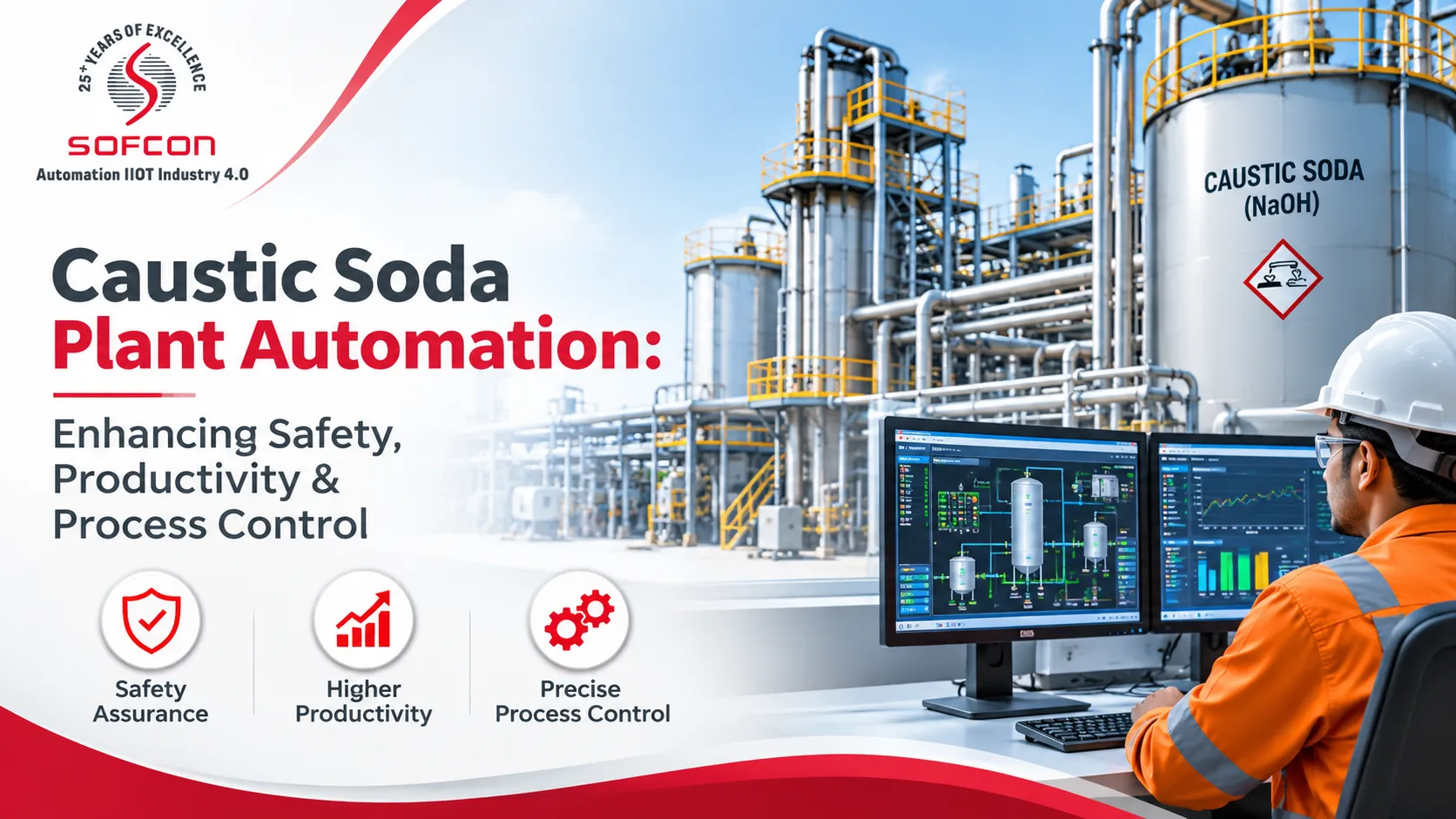
Caustic Soda Plant Automation: Enhancing Safety, Productivity & Process Control
Caustic soda (sodium hydroxide or NaOH) is an essential chemical used across industries such as textiles, pulp and paper, pharmaceuticals, water treatment, chemicals, and detergents. Its manufacturing process involves high electrical consumption, corrosive chemicals, hazardous gases, and complex operating conditions that require precise monitoring and control.
As chemical manufacturers focus on operational safety, production efficiency, and energy optimization, Caustic Soda Plant Automation has become an important part of modern industrial operations.
Advanced automation technologies, including Programmable Logic Controllers (PLC), Distributed Control Systems (DCS), Supervisory Control and Data Acquisition (SCADA), and Industrial Internet of Things (IIoT), help manufacturers achieve stable operating conditions, improve equipment reliability, and monitor production activities in real time.
From brine purification and electrolysis to chlorine handling and caustic soda concentration, industrial automation supports consistent production, improved process visibility, and safer plant operations.
Sofcon Systems, an industrial automation and engineering solutions provider, offers control system integration, instrumentation, and automation capabilities relevant to chemical manufacturing facilities.
What Is Caustic Soda Plant Automation?
Caustic Soda Plant Automation is the integration of industrial control systems, sensors, instrumentation, and monitoring technologies to automatically regulate and supervise the manufacturing of sodium hydroxide.
It involves monitoring critical process parameters such as temperature, pressure, electrical current, voltage, brine concentration, chemical flow rates, and equipment performance.
Instead of relying entirely on manual supervision, automated systems continuously collect process data, adjust operating parameters within approved limits, and notify operators when abnormal conditions occur.
The primary objectives of caustic soda manufacturing automation include:
- Improving operational safety and process reliability
- Maintaining consistent caustic soda quality
- Optimizing electricity and steam consumption
- Reducing equipment downtime
- Improving production efficiency
- Supporting faster fault identification
- Enabling centralized plant monitoring
- Providing accurate operational data for decision-making
A properly designed automation system allows plant operators to maintain better control over complex chemical manufacturing processes.
Understanding the Caustic Soda Manufacturing Process
Caustic soda is primarily produced using the chlor-alkali process, which involves the electrolysis of purified sodium chloride solution, commonly known as brine.
The overall chemical reaction is:
2NaCl + 2H₂O → 2NaOH + Cl₂ + H₂
This process produces three valuable chemicals: sodium hydroxide, chlorine, and hydrogen.
Modern chlor-alkali manufacturing commonly uses membrane-cell electrolysis technology, which separates the chemical products while supporting efficient production.
Key Stages of Caustic Soda Production
- Brine Preparation and Purification
Salt is dissolved in water to prepare brine. Impurities, including calcium and magnesium, are removed to protect membrane performance and maintain process efficiency.
- Membrane Cell Electrolysis
Purified brine passes through electrolytic cells, where direct electrical current drives chemical reactions that generate caustic soda, chlorine, and hydrogen.
- Caustic Soda Concentration
The sodium hydroxide solution produced in membrane cells is concentrated through evaporation to meet commercial specifications.
- Chlorine Processing
Chlorine gas undergoes cooling, drying, purification, and additional treatment depending on the intended application.
- Hydrogen Processing
Hydrogen is collected, treated, and handled under controlled conditions for suitable industrial applications.
- Product Storage and Handling
Finished chemicals are transferred to storage and distribution systems designed for their respective physical and chemical properties.
Each stage requires reliable instrumentation, process monitoring, and carefully designed control systems.
Why Is Automation Essential in Caustic Soda Manufacturing Plants?
Caustic soda plants operate under demanding conditions, where unexpected equipment failures or process disturbances can affect product quality, plant availability, and personnel safety.
Traditional control arrangements may provide limited visibility across interconnected production sections. Operators may also need to monitor multiple instruments and equipment systems separately.
Chlor-Alkali Plant Automation helps address these challenges by integrating plant operations into coordinated control and monitoring systems.
Major Operational Challenges
- Variations in brine purity and concentration
- Electrolyzer temperature and voltage fluctuations
- High electricity consumption during electrolysis
- Steam consumption in caustic concentration systems
- Chlorine leakage and hydrogen-related hazards
- Unplanned pump, compressor, or rectifier failures
- Inconsistent process performance
- Delayed detection of equipment abnormalities
By monitoring these conditions continuously, automation systems help plant operators identify deviations and respond more effectively.
Key Applications of Caustic Soda Plant Automation
1. Automated Brine Preparation and Purification
Brine purity is critical for membrane-cell electrolysis because impurities can affect membrane performance and increase operating costs.
Automated brine purification systems help maintain consistent feed quality through accurate monitoring and process control.
Important applications include:
- Automatic brine flow control
- pH monitoring and chemical dosing
- Brine concentration measurement
- Filtration and purification monitoring
- Storage tank level control
- Online impurity analyzer integration
- Automated pump and valve operation
- Real-time process alarms
These systems support stable brine treatment and help protect downstream electrolysis equipment.
2. Membrane Cell Electrolysis Automation
The electrolyzer is the core production unit in a caustic soda plant.
Electrolysis performance depends on maintaining suitable electrical and process conditions.
Advanced PLC and DCS automation can monitor:
- Electrolyzer current and voltage
- Cell operating temperature
- Brine and caustic flow rates
- Electrolyzer pressure and differential pressure
- Caustic concentration
- Rectifier operating parameters
- Electrical load variations
- Equipment alarms and operating status
Automated control helps maintain stable operating conditions and allows operators to identify changes that may affect current efficiency or equipment performance.
3. Chlorine and Hydrogen Safety Automation
Chlorine and hydrogen handling presents significant safety challenges.
Chlorine is toxic, while hydrogen is highly flammable. Appropriate engineering controls are necessary to protect workers, equipment, and surrounding facilities.
Automation can support safety management through:
- Chlorine gas detection and alarm systems
- Hydrogen leak detection
- Gas pressure and temperature monitoring
- Ventilation system monitoring
- Automated isolation functions
- Emergency shutdown integration
- Safety interlocks
- Alarm and event logging
Safety-critical functions must be developed using appropriate hazard assessments, safety instrumented systems, and relevant engineering standards. Routine PLC or SCADA monitoring must not replace independently required protective safeguards.
These technologies help facilities detect abnormal conditions and execute predefined protective actions.
4. Caustic Soda Concentration and Evaporation Control
Caustic soda produced through membrane-cell electrolysis typically requires further concentration before commercial use.
Evaporation systems must maintain controlled temperature, pressure, steam consumption, and solution concentration.
Automation applications include:
- Evaporator temperature monitoring
- Steam flow and pressure control
- Caustic soda concentration measurement
- Feed flow regulation
- Automatic level control
- Pump and valve sequencing
- Process alarms and historical trends
Automated evaporation control supports consistent product concentration and helps identify opportunities to improve thermal efficiency.
5. Automated Product Storage and Transfer
Chemical storage and transfer systems require careful management to avoid equipment damage, overflow, contamination, and operational interruptions.
Automation can provide tank level monitoring, pump control, transfer sequencing, temperature measurement, and overfill protection integration.
Centralized monitoring also helps operators track product inventory and transfer operations more effectively.
Role of PLC, DCS and SCADA in Caustic Soda Plant Automation
Different industrial automation technologies perform complementary functions across a caustic soda manufacturing facility.
| Technology | Key Function | Application |
| PLC | Equipment-level control and sequencing | Pumps, motors, valves and filtration units |
| DCS | Continuous process monitoring and control | Electrolysis, brine purification and evaporation |
| SCADA | Centralized visualization and data acquisition | Plant dashboards, alarms and reporting |
| HMI | Operator interaction | Equipment status and process controls |
| IIoT | Connected data acquisition and analytics | Equipment condition and performance monitoring |
| SIS | Independent safety instrumented protection where required | Safety shutdown and protective functions |
PLC Automation for Equipment Control
Programmable Logic Controllers automate equipment operations, sequencing, and machine-level control.
They are commonly used for pumps, valves, motors, and auxiliary plant systems.
DCS for Continuous Process Control
Distributed Control Systems are especially suitable for complex processes that require coordinated control across multiple operating sections.
A DCS enables engineers and operators to monitor interconnected variables from centralized control interfaces.
SCADA for Real-Time Plant Monitoring
SCADA systems provide visual dashboards, alarm notifications, historical trends, and equipment status information.
They help plant personnel monitor production operations and investigate process disturbances.
When integrated correctly, these technologies improve operational visibility and support coordinated plant management.
How Automation Enhances Safety in Caustic Soda Plants
Safety is a critical priority in chemical manufacturing, particularly where hazardous gases, corrosive liquids, electrical equipment, and pressurized systems are involved.
Industrial automation contributes to safer operations through continuous monitoring and engineered protection.
Real-Time Hazard Monitoring
Gas detectors and field instruments monitor critical conditions and provide alerts when defined thresholds are exceeded.
Emergency Shutdown and Safety Interlocks
Properly engineered safety functions can initiate predefined protective actions when hazardous conditions develop.
Reduced Manual Intervention
Remote monitoring and automatic process control can reduce the need for workers to perform routine adjustments near hazardous equipment.
Centralized Alarm Management
Operators can review alarms and abnormal events through dedicated interfaces, improving situational awareness.
Operational Traceability
Historical process records help maintenance and engineering teams investigate faults, review plant performance, and identify recurring operating issues.
Safety improvements depend on appropriate system design, risk assessment, training, testing, and maintenance—not automation technology alone.
Improving Productivity and Process Control Through Automation
Consistent production is essential for maintaining the operational and financial performance of caustic soda plants.
Industrial automation helps manufacturers manage production processes more effectively.
Stable Production Conditions
Automated control loops maintain critical operating parameters within approved ranges, supporting consistent manufacturing performance.
Reduced Equipment Downtime
Continuous monitoring helps maintenance teams detect abnormal equipment behavior before it results in major failures.
Better Product Consistency
Precise regulation of concentration, temperature, and flow supports stable chemical production.
Improved Production Visibility
Centralized dashboards allow managers to monitor plant output, operating conditions, and equipment availability.
Faster Troubleshooting
Historical trends, alarm records, and equipment diagnostics help engineers identify potential causes of process disturbances.
These capabilities support continuous improvement and more efficient plant operations.
Energy Efficiency and Cost Optimization in Caustic Soda Plants
Energy consumption is a major operating consideration in chlor-alkali manufacturing.
Electrolysis requires substantial electrical power, while evaporation, pumping, cooling, compression, and other auxiliary operations also consume energy.
Caustic Soda Plant Automation supports energy optimization by improving the visibility and control of energy-intensive equipment.
Electrolyzer Energy Monitoring
Automation systems can track electrical current, voltage, rectifier performance, and specific electricity consumption.
Analyzing these parameters helps engineers evaluate operating efficiency and identify unusual consumption patterns.
Variable Frequency Drives
Variable Frequency Drives (VFDs) can improve the efficiency of suitable variable-load motor applications.
They allow equipment such as pumps and fans to operate according to actual process demand.
Steam Consumption Optimization
Evaporation control systems can monitor steam utilization and help maintain stable thermal operating conditions.
Utility Monitoring
Connected dashboards can display electricity, steam, compressed air, and water consumption across plant sections.
Energy Performance Analysis
Historical data enables manufacturers to compare operational performance across production periods and identify opportunities for energy reduction.
Actual energy savings depend on the existing plant configuration, technology, equipment condition, and engineering improvements implemented.
Industry 4.0 and IIoT in Modern Caustic Soda Manufacturing
Industry 4.0 technologies enable chemical manufacturers to move beyond basic equipment automation toward connected, data-driven operations.
Industrial IoT platforms collect operational information from machines, sensors, and control systems to provide deeper visibility into production performance.
Predictive Maintenance
Equipment condition data can be analyzed to identify developing faults in pumps, compressors, motors, and other rotating equipment.
This helps maintenance teams plan inspections and repairs more effectively.
Real-Time Performance Dashboards
Digital dashboards provide centralized information on production, equipment availability, energy consumption, and process conditions.
Advanced Process Analytics
Historical operating data can help engineers examine relationships between electrolysis performance, energy consumption, and process stability.
Remote Equipment Monitoring
Secure remote monitoring allows authorized personnel to review equipment information without being physically present at every plant location.
Industrial Data Integration
Connected automation platforms can integrate plant operating data with reporting tools, historians, and manufacturing information systems.
These capabilities support operational transparency, better maintenance planning, and continuous process improvement.
Important KPIs for Caustic Soda Plant Performance
Measuring automation performance requires selecting operational indicators aligned with plant objectives.
| KPI | What It Measures |
| Specific electricity consumption | Electrical energy used per tonne of caustic soda |
| Electrolyzer current efficiency | Effectiveness of current utilization |
| Production output | Quantity of caustic soda produced |
| Plant availability | Percentage of time the plant is available for operation |
| Unplanned downtime | Duration of unexpected operational interruptions |
| Steam consumption | Thermal energy use in concentration operations |
| Brine purity | Quality of feed supplied to electrolysis |
| Product concentration | Consistency of finished caustic soda |
| Equipment fault frequency | Recurring operational abnormalities |
| Safety system demand events | Occurrences requiring protective system action |
A properly integrated control and reporting system makes these indicators easier to monitor and analyze.
Common Challenges in Caustic Soda Plant Automation Projects
Despite its advantages, automation modernization requires careful planning.
Integration with Legacy Equipment
Existing plants may use older controllers, instruments, and communication protocols that require interface engineering.
Industrial Cybersecurity
Connected control systems must be protected through secure network architecture, access controls, monitoring, and appropriate maintenance procedures.
Process Safety Requirements
Modifications affecting critical processes require formal risk assessments, management of change, and relevant functional safety reviews.
Operator Training
Personnel must understand the automation system, operating procedures, alarms, and approved responses to abnormal conditions.
Maintenance and Lifecycle Management
Controllers, instruments, industrial networks, and software require ongoing maintenance and periodic upgrades.
Addressing these challenges during project planning improves the likelihood of successful automation implementation.
How to Implement Caustic Soda Plant Automation Successfully
A structured automation implementation approach helps manufacturers modernize existing plants while managing technical and operational risks.
Step 1: Assess Existing Infrastructure
Review current instrumentation, controllers, electrical systems, industrial networks, and equipment condition.
Step 2: Identify Automation Priorities
Determine which production sections require improved monitoring, equipment control, safety integration, or energy management.
Step 3: Develop System Architecture
Select appropriate PLC, DCS, SCADA, and instrumentation solutions according to process requirements.
Step 4: Complete Detailed Engineering
Prepare control narratives, instrumentation specifications, I/O lists, control logic, communication architecture, and safety integration requirements.
Step 5: Integrate and Test Systems
Carry out applicable Factory Acceptance Testing (FAT), Site Acceptance Testing (SAT), loop checks, and control function verification.
Step 6: Commission and Train
Implement approved commissioning procedures and train relevant operating and maintenance personnel.
Step 7: Monitor Performance
Evaluate production efficiency, equipment reliability, energy consumption, and operational data after commissioning.
A phased modernization strategy can be particularly useful for existing plants where production interruptions must be carefully managed.
Why Choose Sofcon Systems for Industrial Automation Solutions?
Selecting the right automation partner is important for manufacturers seeking reliable control systems and long-term operational efficiency.
Sofcon Systems provides industrial automation, instrumentation, control engineering, and system integration services for a range of manufacturing and process industries.
As an established Industrial Automation Company India, Sofcon Systems offers engineering capabilities relevant to manufacturers planning automation upgrades, system integration, and digital transformation.
Comprehensive Automation Expertise
Sofcon Systems offers services including:
- PLC programming and integration
- DCS engineering and configuration
- SCADA development and HMI design
- Industrial instrumentation integration
- Substation and electrical automation
- Industrial control panel engineering
- Industry 4.0 and IIoT solutions
- Automation testing and commissioning
- Maintenance and technical support
Customized Industrial Automation Solutions
Industrial plants have different operating requirements, equipment configurations, and production challenges.
Sofcon Systems provides engineering-oriented solutions that can be adapted to specific industrial applications.
End-to-End Engineering Capabilities
From automation system design and programming to integration, testing, and commissioning, Sofcon Systems supports multiple stages of industrial automation projects.
Industrial Digital Transformation
Its automation and IIoT capabilities help businesses explore real-time monitoring, equipment connectivity, operational analytics, and smart manufacturing technologies.
For chemical manufacturers evaluating caustic soda plant modernization, these capabilities can form part of a comprehensive automation strategy.
Contact Sofcon Systems
Phone: +91-98110-87224
Website: https://www.sofcononline.com/
FAQs
1. What Is Caustic Soda Plant Automation?
Caustic soda plant automation uses PLC, DCS, SCADA, instrumentation, and monitoring technologies to regulate and supervise sodium hydroxide manufacturing operations. It improves process visibility, production consistency, and operational control.
2. Which Automation System Is Best for a Caustic Soda Plant?
The most suitable system depends on plant size, process complexity, and operational requirements. DCS is commonly suited to continuous process control, while PLCs handle equipment-level operations and SCADA provides centralized monitoring.
3. How Does Automation Improve Safety in Chlor-Alkali Plants?
Automation integrates gas monitoring, alarm management, process instrumentation, and appropriately engineered protective functions. Dedicated safety systems are required where identified by the plant’s risk assessment.
4. Can Automation Reduce Electricity Consumption in Caustic Soda Plants?
Automation helps monitor electrolysis performance, identify abnormal energy consumption, and optimize suitable equipment operations. Energy reductions depend on process conditions and the improvements implemented.
5. What Is the Role of DCS in Caustic Soda Manufacturing?
A Distributed Control System coordinates continuous process control across important production stages, including brine preparation, electrolysis, evaporation, and auxiliary systems.
6. How Is IIoT Used in Caustic Soda Plants?
IIoT connects industrial equipment and instruments to monitoring and analytics platforms. It supports production visibility, equipment condition monitoring, energy analysis, and maintenance planning.
7. Can an Existing Caustic Soda Plant Be Automated?
Yes. Existing plants can often be upgraded through controller modernization, additional instrumentation, SCADA integration, and improved monitoring, subject to engineering and safety assessments.
8. How Do Manufacturers Measure Automation ROI?
Automation return on investment can be assessed by comparing project and lifecycle costs with measurable improvements in downtime, energy use, maintenance expenditure, production efficiency, and product quality.
Conclusion
Caustic Soda Plant Automation is an important investment for chemical manufacturers seeking to improve safety, productivity, process control, and energy efficiency.
By integrating PLC, DCS, SCADA, industrial instrumentation, and IIoT technologies, manufacturers can achieve better visibility into production processes, maintain more consistent operating conditions, and identify opportunities for operational improvement.
From brine purification and membrane-cell electrolysis to chlorine handling, evaporation, and utility management, automation supports reliable operations across the chlor-alkali manufacturing process.
For businesses planning to modernize industrial control systems, Sofcon Systems offers automation engineering, instrumentation, and digital integration capabilities that can support long-term industrial efficiency.
Looking to Improve Your Caustic Soda Plant Automation?
Connect with Sofcon Systems to discuss industrial automation, process control, and digital transformation solutions for your manufacturing facility.
Call: +91-98110-87224
Website: https://www.sofcononline.com/