
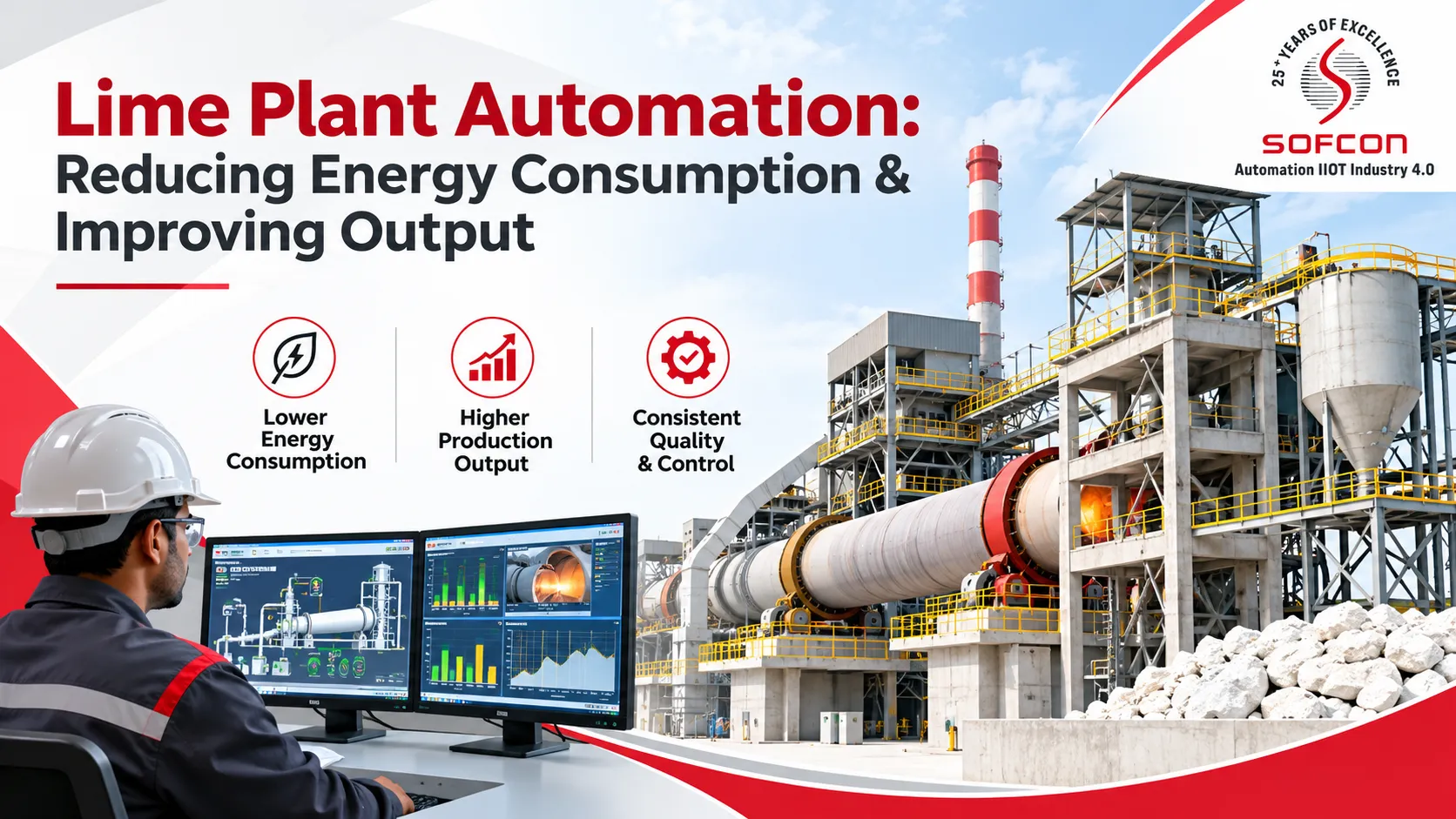
Lime Plant Automation: Reducing Energy Consumption & Improving Output
Lime manufacturing plays an important role in industries such as steel production, construction, chemical processing, mining, water treatment, and environmental management. As industrial demand for high-quality lime continues, manufacturers are focusing on improving production efficiency, controlling energy expenses, and maintaining consistent product quality.
However, lime production is an energy-intensive process. The conversion of limestone into quicklime requires high-temperature calcination, making fuel consumption, kiln performance, and process stability critical factors in overall plant profitability.
Lime Plant Automation helps manufacturers address these challenges by integrating advanced control systems, real-time process monitoring, and intelligent production management technologies.
With PLC, DCS, SCADA, industrial instrumentation, and Industry 4.0 solutions, lime producers can regulate kiln operating conditions, optimize fuel utilization, reduce process variations, and improve production reliability.
Companies such as Sofcon Systems provide industrial automation and engineering solutions that support manufacturing facilities in achieving more efficient and controlled operations.
What Is Lime Plant Automation?
Lime Plant Automation refers to the use of industrial control systems, sensors, software, and automated equipment to monitor and regulate the lime manufacturing process.
It involves automating critical production activities, including limestone feeding, kiln temperature control, fuel supply, combustion air regulation, lime discharge, material handling, and production monitoring.
The primary objectives of automation in lime manufacturing are to:
- Reduce fuel and electricity consumption
- Improve kiln thermal efficiency
- Increase consistent production output
- Maintain uniform lime quality
- Minimize unplanned equipment downtime
- Improve process safety and reliability
- Reduce manual intervention in repetitive operations
- Provide real-time production and energy data
By integrating these functions into a centralized control system, manufacturers can make better operational decisions and maintain more stable production conditions.
Understanding the Lime Manufacturing Process
Lime is produced by heating limestone, primarily composed of calcium carbonate (CaCO₃), to temperatures sufficient to release carbon dioxide and form calcium oxide (CaO), commonly known as quicklime.
The chemical reaction is:
CaCO₃ + Heat → CaO + CO₂
This process is called calcination.
Calcium carbonate begins decomposing under suitable conditions at elevated temperatures, with industrial calcination generally requiring temperatures around or above 900°C, depending on carbon dioxide partial pressure and operating conditions. Actual kiln temperature profiles are determined by kiln design, fuel characteristics, and the required product quality.
Major Stages of Lime Production
- Limestone Crushing and Screening
Raw limestone is crushed and screened to achieve the required particle size for the selected kiln technology.
- Limestone Feeding
Prepared limestone is transferred into the kiln through controlled feeding systems.
- Calcination
Limestone is heated inside a rotary kiln or shaft kiln, allowing calcium carbonate to decompose into quicklime and carbon dioxide.
- Cooling
Hot quicklime is cooled using an appropriate cooling system. Some kiln configurations recover heat from the cooling stage.
- Product Handling and Storage
Finished quicklime is transported to storage silos or further processing systems.
- Hydration or Slaking (Where Required)
Quicklime may undergo controlled hydration to produce hydrated lime, depending on the final product requirements.
Each stage influences energy consumption, production capacity, and finished lime quality.
Why Is Automation Important in Lime Manufacturing Plants?
Lime production requires precise control of high-temperature equipment and continuous coordination between material feeding, combustion, kiln operation, and product discharge.
Manual operating methods may lead to inconsistent temperature profiles, inefficient fuel utilization, unstable production rates, and delayed fault detection.
Lime Manufacturing Process Automation addresses these challenges by providing continuous monitoring and automated regulation of important process parameters.
Common Challenges in Conventional Lime Plants
- High fuel consumption during calcination
- Unstable kiln temperature profiles
- Variation in limestone feed rate and particle size
- Excessive or insufficient combustion air
- Inconsistent quicklime quality
- Equipment wear and unexpected shutdowns
- Limited visibility into energy consumption
- Heat losses through exhaust gases and equipment surfaces
- Difficulty maintaining stable production output
An integrated automation system helps plant operators identify these conditions and implement appropriate corrective actions.
How Lime Plant Automation Reduces Energy Consumption
Energy efficiency is one of the most important benefits of automation in lime manufacturing.
The calcination process requires substantial thermal energy, while fans, conveyors, crushers, motors, and auxiliary equipment consume electricity.
Modern automation technologies help manage both thermal and electrical energy consumption.
1. Automated Kiln Temperature Control
Maintaining the correct kiln temperature is essential for efficient calcination.
Insufficient heat can result in underburned lime, while excessive heat exposure can increase fuel consumption, affect lime reactivity, and damage refractory materials.
Automated control systems use temperature sensors, fuel flow measurements, and process feedback to regulate kiln operating conditions.
Key advantages include:
- Stable operating temperature profiles
- Reduced unnecessary fuel input
- Improved consistency of calcination
- Lower risk of temperature-related process disturbances
- Better protection of kiln refractory materials
- Improved overall process stability
For lime manufacturers, stable temperature control helps balance energy use with product quality requirements.
2. Fuel and Combustion Air Optimization
Efficient combustion depends on the proper relationship between fuel supply, combustion air, and kiln operating conditions.
Excess combustion air can increase heat losses through exhaust gases, while insufficient air can cause incomplete combustion and unsafe operating conditions.
PLC and DCS-based combustion control systems can coordinate:
- Fuel flow regulation
- Combustion air flow
- Oxygen concentration monitoring
- Burner operating conditions
- Kiln draft control
- Exhaust gas temperature monitoring
- Combustion-related alarms
Automated combustion management helps operators maintain efficient operating conditions within approved safety limits.
3. Variable Frequency Drives for Energy-Efficient Motors
Lime plants use numerous electric motors for fans, conveyors, pumps, and other equipment.
Where process requirements permit variable-speed operation, Variable Frequency Drives (VFDs) can adjust motor speeds according to actual demand.
Potential applications include:
- Induced draft fans
- Forced draft fans
- Suitable material handling systems
- Pumps and auxiliary equipment
- Selected ventilation systems
In appropriate variable-load applications, VFDs can reduce unnecessary electricity consumption compared with continuously operating at full speed.
4. Waste Heat Recovery Monitoring
Lime kilns release substantial heat through exhaust gases and hot product streams.
Depending on the kiln design, some of this heat can be recovered for applications such as combustion air preheating or other suitable thermal uses.
Automation can support waste heat recovery through:
- Exhaust gas temperature monitoring
- Air flow regulation
- Heat exchanger performance monitoring
- Temperature difference tracking
- Automated equipment control
- Energy recovery reporting
The effectiveness of heat recovery depends on equipment configuration, operating conditions, and the economic feasibility of the recovery system.
5. Real-Time Energy Monitoring
Energy monitoring systems provide valuable information about how fuel and electricity are consumed across a lime plant.
Integrated SCADA or IIoT dashboards can display:
- Fuel consumption per hour
- Electricity consumption
- Kiln operating temperatures
- Production output
- Energy use per tonne of quicklime
- Equipment operating hours
- Energy consumption trends
These insights help plant managers identify inefficiencies and evaluate energy improvement initiatives.
Improving Lime Production Output Through Automation
Increasing production output is not simply a matter of feeding more limestone into the kiln.
A higher feed rate without adequate process control can result in incomplete calcination, excessive fuel demand, unstable kiln conditions, and inconsistent product quality.
Lime Kiln Automation helps manufacturers increase sustainable production performance by coordinating feed rates, heat input, residence time, and equipment operation.
Automated Limestone Feeding
Consistent limestone feeding is essential for maintaining stable kiln conditions.
Automated feeding systems can regulate material flow using weighing devices, feeders, sensors, and control logic.
This helps reduce sudden variations in kiln loading and supports predictable production.
Optimized Kiln Operation
Advanced control systems coordinate important operating variables such as:
- Limestone feed rate
- Kiln temperature
- Fuel input
- Combustion air supply
- Draft and pressure
- Material residence time
- Product discharge rate
Coordinated control helps reduce unnecessary process fluctuations.
Reduced Equipment Downtime
Continuous monitoring of motors, fans, conveyors, and kiln-related equipment helps maintenance teams detect developing operating problems.
Timely fault detection can prevent minor equipment issues from escalating into major production interruptions.
Improved Product Consistency
Stable process conditions help manufacturers maintain more consistent lime properties.
Depending on the application, important quality parameters may include:
- Available calcium oxide content
- Residual calcium carbonate
- Lime reactivity
- Particle size
- Bulk density
- Product moisture
Product quality typically requires laboratory or validated online measurement, with automation using the results to support process adjustments.
PLC, DCS and SCADA Applications in Lime Plant Automation
Industrial automation technologies form the foundation of modern lime manufacturing control systems.
PLC Automation for Lime Plants
A Programmable Logic Controller (PLC) provides reliable equipment control and automated sequencing for industrial machinery.
Typical PLC applications in lime plants include:
- Limestone feeders and conveyors
- Crushers and screening equipment
- Kiln auxiliary equipment
- Motor control systems
- Automated valves and dampers
- Cooling equipment
- Product discharge systems
- Equipment interlocks
PLC automation helps reduce repetitive manual intervention and improves equipment coordination.
DCS Automation for Continuous Process Control
A Distributed Control System (DCS) is suitable for facilities requiring coordinated monitoring and regulation of multiple continuous processes.
DCS applications may include:
- Kiln temperature control
- Fuel and combustion air regulation
- Process pressure monitoring
- Production rate control
- Kiln draft management
- Integrated alarm management
- Historical process data analysis
A DCS can help plant operators maintain consistent operating conditions across interconnected production sections.
SCADA Systems for Real-Time Plant Monitoring
Supervisory Control and Data Acquisition (SCADA) systems provide centralized monitoring and visualization of industrial operations.
A lime plant SCADA system can display:
- Kiln operating status
- Temperature profiles
- Fuel consumption
- Limestone feed rates
- Motor and equipment conditions
- Production quantities
- Alarm notifications
- Energy consumption reports
- Equipment downtime history
With real-time information available through operator dashboards, plant teams can identify abnormalities and make more informed operational decisions.
Advanced Process Control for Lime Kiln Optimization
Beyond conventional PLC and DCS control, manufacturers can explore Advanced Process Control (APC) to optimize complex kiln operations.
Lime kilns respond gradually to changes in feed rate, fuel input, and combustion conditions. This makes process optimization challenging when operators rely only on individual control loops.
Advanced control methods, including Model Predictive Control (MPC), can evaluate interactions between multiple process variables and adjust control targets within defined operating constraints.
Potential APC Applications
- Coordinated fuel and feed control
- Temperature profile stabilization
- Oxygen and draft optimization
- Production rate adjustments
- Reduction of process fluctuations
- Energy performance optimization
- Consistent product quality management
These solutions require reliable instrumentation, validated process models, and appropriate operating safeguards.
When implemented correctly, advanced control can complement existing automation systems and support more stable kiln operation.
How Automation Improves Lime Quality
Lime quality is determined by several interconnected factors, including limestone composition, particle size, calcination temperature, residence time, and kiln operating conditions.
Inadequate control can result in underburned material or excessively hard-burned lime that does not meet the intended application requirements.
Automation helps improve quality management through:
- Consistent limestone feed regulation
- Stable kiln temperature control
- Controlled residence time
- Fuel and air flow coordination
- Product sampling and testing integration
- Historical quality trend analysis
- Automated production records
For industries such as steel manufacturing and chemical processing, consistent lime quality is important for dependable downstream operations.
Role of Industry 4.0 and IIoT in Lime Plant Automation
Traditional plant automation focuses on monitoring and controlling machinery.
Industry 4.0 and Industrial Internet of Things (IIoT) technologies extend these capabilities by connecting equipment data with analytical tools and production management systems.
Real-Time Production Dashboards
Connected dashboards allow authorized users to monitor kiln performance, production output, equipment conditions, and energy consumption.
Predictive Maintenance
Condition-monitoring systems can track equipment indicators such as:
- Bearing temperature
- Motor current
- Vibration levels
- Equipment operating hours
- Fan performance
- Gearbox condition
These measurements can help identify potential maintenance needs before major equipment failures occur.
Production Data Analytics
Historical operating data can be analyzed to identify relationships between fuel consumption, production rate, raw material characteristics, and product quality.
Automated Performance Reporting
Digital reporting tools can generate production summaries, energy performance reports, and maintenance records.
Secure Industrial Connectivity
Industrial networks can connect compatible PLC, DCS, and SCADA systems with selected analytics platforms.
Secure design should include appropriate network segmentation, access controls, monitoring, and protection of critical control functions.
Safety and Environmental Monitoring in Lime Plants
Lime manufacturing involves high-temperature equipment, combustion systems, rotating machinery, dust, and potentially hazardous gases.
Automation helps improve operational visibility and supports appropriate safety procedures.
Important Safety Applications
- Kiln overheating alarms
- Burner management and flame supervision
- Combustion air and fuel safety interlocks
- Carbon monoxide monitoring where required
- Equipment overload detection
- Emergency shutdown functions
- Conveyor safety monitoring
- Controlled start-up and shutdown sequences
Safety-critical functions require dedicated engineering, suitable protective systems, and validation according to the plant’s risk assessment.
Environmental Monitoring
Automation also supports the monitoring of environmental performance through:
- Dust collection equipment status
- Bag filter differential pressure monitoring
- Exhaust gas temperature measurement
- Stack emissions monitoring where required
- Fuel consumption tracking
- Process event recording
Automation can help identify inefficient operating conditions, but emission reductions depend on process design, combustion characteristics, abatement equipment, and operating practices.
Important KPIs for Evaluating Lime Plant Automation Performance
Manufacturers should evaluate automation investments through measurable performance indicators.
| KPI | What It Measures |
| Specific thermal energy consumption (GJ/tonne) | Fuel energy consumed per tonne of quicklime |
| Specific electricity consumption (kWh/tonne) | Electrical energy consumed per tonne |
| Production output (tonnes/day) | Daily lime production |
| Kiln availability (%) | Percentage of time the kiln is available for production |
| Unplanned downtime (hours) | Time lost due to unexpected failures |
| Fuel consumption rate | Fuel use over a defined period |
| Available CaO content (%) | Important product quality indicator |
| Residual carbonate (%) | Indicator of incomplete calcination |
| Lime reactivity | Product performance indicator |
| Emissions monitoring results | Environmental performance against applicable limits |
Tracking these KPIs before and after automation helps manufacturers evaluate improvements and identify further optimization opportunities.
How to Upgrade an Existing Lime Plant with Automation
Existing lime manufacturing facilities can often be modernized without replacing every major item of production equipment.
A phased automation strategy can help reduce disruption while addressing the most important process challenges.
Step 1: Assess Existing Plant Operations
Review kiln performance, instrumentation, control panels, fuel systems, maintenance history, and existing automation infrastructure.
Step 2: Identify Energy Losses and Production Bottlenecks
Study fuel consumption, operating temperature variations, material feeding problems, and recurring equipment failures.
Step 3: Design the Automation Architecture
Select appropriate PLC, DCS, SCADA, industrial sensors, and communication systems based on plant requirements.
Step 4: Integrate Equipment and Instrumentation
Connect suitable field devices, drives, motors, measurement instruments, and process control equipment.
Step 5: Implement Monitoring and Control
Develop operator dashboards, control sequences, alarm systems, historical trends, and reporting functions.
Step 6: Test and Commission the System
Conduct applicable Factory Acceptance Testing (FAT), Site Acceptance Testing (SAT), equipment verification, and control function testing.
Step 7: Measure Performance and Optimize
Compare production output, fuel consumption, energy intensity, quality, and downtime with the established baseline.
This allows manufacturers to evaluate actual improvements rather than relying on assumptions.
How to Calculate ROI from Lime Plant Automation
The financial value of automation depends on plant capacity, current operating performance, energy prices, equipment condition, and implementation costs.
A practical evaluation should include both direct cost savings and operational improvements.
Potential Sources of Savings
- Fuel Cost Reduction
Improved combustion control and process stability may reduce fuel consumption per tonne of acceptable quicklime.
- Electricity Savings
Suitable motor speed control, monitoring, and equipment optimization can reduce auxiliary electricity usage.
- Reduced Maintenance Costs
Condition monitoring and improved operating stability can help reduce avoidable equipment damage and unexpected maintenance.
- Improved Production Yield
More consistent calcination can reduce off-spec production and support higher saleable output.
- Reduced Downtime
Improved fault monitoring and equipment coordination can reduce some production interruptions.
Simple ROI Calculation
Annual Net Benefit = Annual Operating Savings + Additional Contribution from Saleable Output − Additional Annual Operating Costs
Simple Payback Period = Total Automation Investment ÷ Annual Net Benefit
Manufacturers should use actual operating data and realistic assumptions to estimate savings and payback.
Automation benefits will vary between facilities, and implementation does not guarantee a specific reduction in energy use or increase in production.
Why Choose Sofcon Systems for Lime Plant Automation?
Choosing the right automation partner is important for manufacturers planning to improve kiln performance, energy efficiency, and production control.
Sofcon Systems provides industrial automation, control engineering, and digital solutions for manufacturing and process industries.
As an experienced Industrial Automation Company India, Sofcon Systems offers engineering capabilities relevant to lime manufacturing, including PLC, DCS, SCADA, instrumentation, and industrial system integration.
Comprehensive Industrial Automation Services
Sofcon Systems offers a range of automation and engineering capabilities:
- PLC programming and automation
- DCS engineering and integration
- SCADA and HMI development
- Industrial instrumentation integration
- Control panel engineering
- Electrical and substation automation
- Industrial communication systems
- Industry 4.0 and IIoT solutions
- Installation, testing, and commissioning
- Automation modernization and technical support
Customized Automation Solutions
Different lime manufacturing facilities have different kiln technologies, production capacities, and operational requirements.
An engineering-focused automation approach helps manufacturers select suitable control technologies instead of relying on a single standard configuration.
Integrated Project Execution
Industrial automation projects require coordination between instrumentation, process engineering, electrical systems, software development, and commissioning.
Sofcon Systems offers capabilities across these technical areas to support automation implementation.
Support for Industrial Digitalization
With experience in industrial automation and digital technologies, Sofcon Systems can support manufacturers seeking improved equipment connectivity, monitoring, and operational data management.
For businesses evaluating Lime Plant Automation Solutions, Sofcon Systems provides relevant engineering and system integration expertise.
Contact Sofcon Systems
Phone: +91-98110-87224
Website: https://www.sofcononline.com/
Frequently Asked Questions About Lime Plant Automation
1. What is lime plant automation?
Lime plant automation uses PLC, DCS, SCADA, industrial sensors, and control software to monitor and regulate limestone feeding, kiln operation, combustion, cooling, and material handling processes.
2. How does lime plant automation reduce energy consumption?
Automation helps reduce energy waste by stabilizing kiln temperatures, optimizing combustion conditions, controlling suitable motor speeds, and providing real-time energy monitoring. Actual savings depend on plant operating conditions.
3. Which automation system is best for a lime kiln?
PLCs are commonly used for equipment sequencing and control, while DCS platforms are suitable for coordinating complex continuous processes. SCADA provides centralized monitoring and visualization. The most suitable architecture depends on kiln design and plant requirements.
4. Can automation increase lime production capacity?
Automation can improve stable production performance by coordinating feed rates, combustion, and kiln operating conditions. However, maximum output remains limited by kiln design, equipment capacity, raw material properties, and product quality requirements.
5. What is the role of SCADA in lime manufacturing?
SCADA provides real-time monitoring of kiln temperature, fuel consumption, production output, equipment status, and alarms. It also supports historical data analysis and operational reporting.
6. Can an existing lime plant be automated?
Yes. Many existing lime plants can be upgraded through instrumentation improvements, PLC or DCS integration, SCADA development, VFD installation, and centralized monitoring, subject to engineering feasibility and safety assessments.
7. What are the main benefits of lime kiln automation?
The main benefits include more stable kiln operation, improved energy management, consistent product quality, reduced manual intervention, improved equipment monitoring, and better production visibility.
8. How does automation improve quicklime quality?
Automation helps maintain consistent operating conditions by controlling limestone feed, combustion, temperature, and other important parameters. This supports more predictable calcination and product quality.
9. Is Industry 4.0 useful for lime manufacturing plants?
Yes. Industry 4.0 technologies can support production analytics, condition monitoring, digital reporting, and improved decision-making using connected industrial equipment and process data.
10. How can lime manufacturers choose an automation partner?
Manufacturers should evaluate technical expertise, experience with continuous industrial processes, PLC and DCS integration capabilities, commissioning practices, safety engineering coordination, and maintenance support.
Conclusion
Lime Plant Automation is an important approach for manufacturers looking to reduce energy consumption, improve kiln efficiency, increase consistent production output, and enhance operational reliability.
By integrating PLC, DCS, SCADA, advanced instrumentation, and Industry 4.0 technologies, lime plants can maintain more stable operating conditions, monitor energy usage, reduce process variations, and improve production visibility.
From automated limestone feeding and kiln temperature control to combustion optimization and predictive maintenance, industrial automation provides opportunities for improving lime manufacturing performance.
For manufacturers planning new automation projects or upgrades to existing facilities, Sofcon Systems offers industrial automation and control engineering solutions that can support more efficient, reliable, and connected operations.
Looking to improve your lime plant’s energy efficiency and production performance?
Connect with Sofcon Systems to discuss your automation, process control, and industrial digitalization requirements.
Phone: +91-98110-87224
Website: https://www.sofcononline.com/