
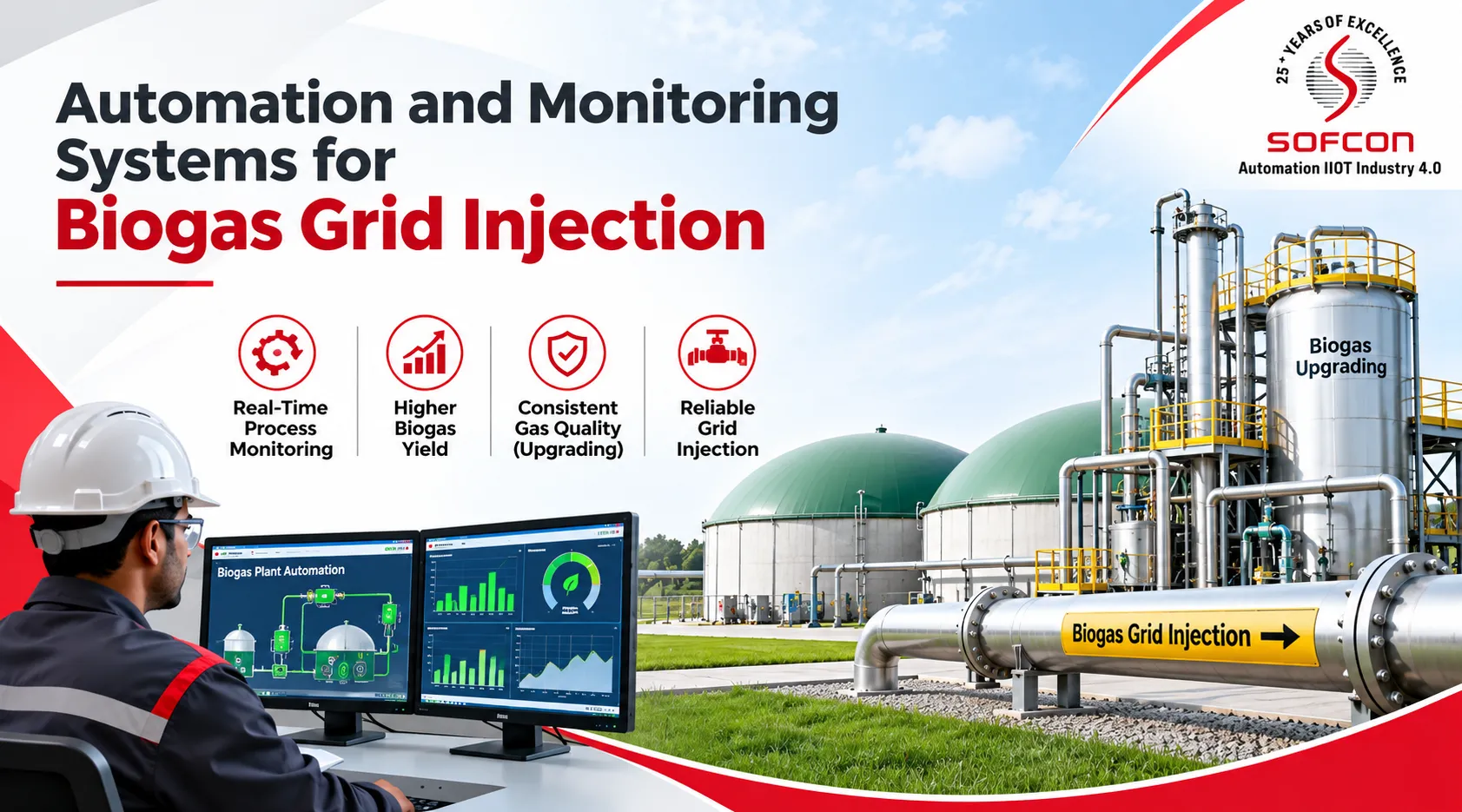
Automation and Monitoring Systems for Biogas Grid Injection
India’s biogas industry is moving beyond renewable gas production toward a more connected energy infrastructure. As compressed biogas (CBG) and biomethane projects expand, injecting upgraded biogas into natural gas pipelines and City Gas Distribution (CGD) networks is becoming an important opportunity for producers.
But producing high-quality biomethane is only half the challenge.
Before renewable gas can enter an existing natural gas network, operators must verify its composition, control delivery pressure, measure flow, monitor equipment conditions, and ensure that unsuitable gas cannot enter the pipeline.
Modern biogas grid injection automation combines gas analyzers, flow meters, pressure transmitters, programmable logic controllers (PLCs), supervisory control and data acquisition (SCADA) systems, and engineered safety interlocks into an integrated monitoring and control architecture.
For CBG producers, EPC contractors, gas distribution companies, and renewable energy developers, understanding how these systems work is critical when designing a reliable biomethane injection facility.
This guide explains the complete process, from gas quality analysis and automated pressure control to SCADA integration, safety systems, Indian regulations, commissioning, and equipment selection.
Key Takeaways
- Grid injection needs verified gas quality, controlled pressure, accurate flow measurement and engineered safety interlocks working together.
- Online analyzers, PLCs and SCADA give operators real-time visibility and an auditable data record.
- Methane purity alone is not enough: moisture, H₂S, oxygen, dew point and temperature must also stay within limits.
- PNGRB’s February 2026 CBG guidelines require online analysis at least every 5 minutes, 60 days of trend storage, weekly analyser calibration and automatic isolation of off-specification gas.
- Safety-critical functions need a validated safety architecture, not a standard PLC or SCADA workstation alone.
What Is Biogas Grid Injection?
Biogas grid injection is the process of introducing suitably upgraded and quality-verified biogas, commonly called biomethane, into an existing natural gas transmission or distribution network.
Raw biogas is produced through anaerobic digestion of organic materials such as agricultural residues, animal waste, food waste, sewage sludge, and other biodegradable feedstocks.
It generally contains methane and carbon dioxide as its major components, along with moisture and varying concentrations of other gases and contaminants.
Before injection into a natural gas network, raw biogas must be treated to meet the applicable gas quality and operating requirements.
The treatment process may include:
- Hydrogen sulfide removal
- Moisture removal and drying
- Carbon dioxide separation
- Removal of other specified contaminants
- Gas compression or pressure regulation
- Gas quality verification
- Flow measurement and delivery control
Once the upgraded gas satisfies the applicable conditions, it can be delivered through a suitably designed injection facility.
Unlike direct biogas combustion, grid injection requires compatibility with the receiving natural gas infrastructure.
This makes measurement, automation, and safety control fundamental parts of the overall system.
Why Are Automation and Monitoring Important for Biogas Grid Injection?
A biogas plant is not a completely static process.
Feedstock characteristics, digester performance, upgrading efficiency, and gas production rates can change over time.
These variations may affect methane concentration, carbon dioxide levels, moisture content, gas flow, and other important operating parameters.
Without appropriate monitoring and automated controls, such changes can create quality, safety, and operational risks.
Maintaining Consistent Biomethane Quality
Gas injected into a network must meet the applicable gas quality specifications.
Online analyzers measure selected components and provide information about whether the gas remains within acceptable limits.
Automated control systems can use validated measurements to determine whether gas delivery may continue.
Preventing Off-Specification Gas Injection
A critical function of an injection system is preventing unsuitable gas from entering the receiving network.
When a monitored parameter exceeds its permitted limit, an engineered interlock can initiate an appropriate response.
Depending on the approved design, this may include isolating the injection line, stopping delivery, or directing gas to a designated handling system.
Controlling Injection Pressure
Gas pressure must be compatible with the receiving pipeline.
Automated pressure regulation helps maintain the required delivery conditions as upstream or downstream operating pressures change.
Improving Operational Visibility
Integrated monitoring allows operators to view gas composition, pressure, flow, temperature, valve positions, and equipment status from a central interface.
Historical data also supports troubleshooting and operational reporting.
Supporting Reliable Plant Operations
Automated monitoring reduces the need for repeated manual readings and enables faster identification of abnormal conditions.
However, automation does not eliminate the need for trained operators, regular inspection, calibration, and preventive maintenance.
For a broader understanding of integrated renewable gas facilities, explore Sofcon’s Biogas Automation Solutions.
How Does an Automated Biogas Grid Injection System Work?
An automated grid injection system coordinates gas treatment, measurement, control, and delivery.
A typical process can be understood through the following sequence.
Raw Biogas Production → Gas Cleaning → Biomethane Upgrading → Gas Quality Analysis → Pressure and Flow Control → Safety Isolation → Grid Injection
The actual arrangement depends on the project design, pipeline requirements, and approved injection configuration.
Gas Production and Upgrading
Raw biogas enters a treatment system where unwanted components are removed or reduced.
The upgrading process increases methane concentration and prepares the gas for its intended application.
Different upgrading technologies may use membranes, pressure swing adsorption, water scrubbing, or other separation methods.
The selected process influences the monitoring instruments and control requirements.
Gas Quality Verification
Before injection, gas analyzers measure the parameters specified for the application.
The system evaluates these measurements against approved limits.
Gas quality verification may involve several instruments because no single analyzer necessarily measures every required parameter.
Pressure and Flow Management
Pressure transmitters, regulators, control valves, and flow meters help manage gas delivery.
The automation system monitors operating conditions and coordinates the relevant equipment.
Injection Permission and Safety Interlocks
A properly engineered control system establishes whether injection conditions are satisfied.
Injection permission may depend on validated gas quality, acceptable pressure, equipment readiness, communication status, and safety system conditions.
Continuous Operational Supervision
During operation, the monitoring system records process measurements, identifies alarms, and communicates relevant information to plant personnel and authorized network operators.
For projects involving gas delivery and quality verification, CBG Grid Injection Monitoring is a particularly relevant Sofcon-solution area.
Key Components of a Biogas Grid Injection Automation System
A reliable CBG grid injection monitoring system generally includes several interconnected technologies.
Each component performs a specific function, but overall system performance depends on their integration.
Online Gas Quality Analyzers
Gas quality analyzers measure selected components or properties of the biomethane stream.
Depending on the analytical requirement, instruments may include gas chromatographs, infrared analyzers, oxygen analyzers, hydrogen sulfide analyzers, and moisture analyzers.
The selection depends on the target parameters, measurement range, response time, applicable standards, and process conditions.
Sofcon’s Gas Monitoring Systems are relevant to industrial applications requiring gas composition and process monitoring.
Gas Chromatographs
Gas chromatography is an important technology for analyzing the composition of natural gas and biomethane.
A gas chromatograph separates selected gas components and measures their concentrations using an appropriate analytical method.
Depending on its configuration, the analyzer can provide composition data used to calculate properties such as calorific value, relative density, and Wobbe Index.
These measurements support gas quality verification and energy-related calculations.
Businesses evaluating analytical equipment can explore Honeywell Elster Gas Chromatographs and Analysers.
Gas Flow Meters
Flow measurement is essential for understanding the quantity of gas delivered into a network.
Depending on the project, suitable technologies may include ultrasonic, turbine, or other approved gas metering systems.
The metering arrangement may also require pressure and temperature measurement, volume conversion, and associated flow-computer functions.
Accurate measurement supports operational reporting and commercial gas accounting.
Pressure Regulators and Control Valves
Pressure regulation equipment maintains appropriate gas delivery conditions.
Control valves may be used to manage flow or pressure according to the approved process design.
Safety shut-off valves provide isolation functions where required.
These devices must be selected for the applicable pressure range, gas characteristics, operating conditions, and safety requirements.
PLC-Based Automation
A programmable logic controller (PLC) processes instrument signals and executes programmed control functions.
In a grid injection facility, a PLC may coordinate equipment sequencing, pressure control, status monitoring, and operational alarms.
Safety-critical functions should be implemented through an appropriately engineered and validated safety architecture rather than assuming that a standard PLC alone is sufficient.
SCADA Monitoring Systems
SCADA for biogas grid injection provides centralized visualization and supervisory monitoring.
Operators can review gas quality measurements, pressure trends, flow rates, alarms, equipment status, and historical data.
SCADA may also support authorized remote access and operational reporting.
Emergency Shutdown and Gas Detection
Gas detection and emergency shutdown systems help protect personnel, equipment, and connected infrastructure.
Depending on the hazard assessment and approved design, they may include combustible gas detectors, emergency stop devices, isolation valves, alarms, and dedicated safety logic.
Communication and Data Logging
Communication systems connect field instruments, analyzers, controllers, and supervisory systems.
Industrial communication protocols such as Modbus may be used where supported by the equipment and project requirements.
Reliable data logging is especially important for gas quality verification, incident investigation, and reporting.
Gas Quality Parameters Monitored Before Biomethane Grid Injection
Biomethane quality monitoring is one of the most important functions of a grid injection system.
The following table explains the main parameters and their operational significance.
| Parameter | Why it matters | Common measurement approach |
| Methane (CH₄) | Major contributor to gas energy content | Gas chromatography or suitable gas analyzer |
| Carbon dioxide (CO₂) | Affects gas composition and heating value | GC or infrared analysis |
| Oxygen (O₂) | Important gas quality and operational parameter | Oxygen analyzer or suitable GC |
| Hydrogen sulfide (H₂S) | Corrosion and gas quality concern | Dedicated H₂S analyzer |
| Moisture / water dew point | Helps prevent condensation and associated problems | Moisture or dew-point analyzer |
| Nitrogen (N₂) | Influences composition and heating value | Gas chromatography |
| Calorific value | Indicates energy content | Calculated from validated composition or measured using an approved method |
| Wobbe Index | Indicates interchangeability-related combustion characteristics | Calculated from appropriate gas properties |
| Gas pressure | Ensures compatibility with injection conditions | Pressure transmitter |
| Gas temperature | Supports safe operation and metering calculations | Temperature transmitter |
| Gas flow | Measures delivery quantity | Approved flow meter and associated instrumentation |
Important: The table identifies common monitoring parameters. It does not replace the complete list of quality requirements established by applicable standards and the receiving network operator.
Why Methane Purity Alone Is Not Enough
A biomethane stream may have a high methane concentration and still fail another gas quality requirement.
For example, moisture, sulfur compounds, oxygen, or other contaminants may exceed permitted limits.
Therefore, grid injection quality assurance must evaluate all applicable parameters rather than relying only on methane percentage.
Why Gas Composition and Energy Value Matter
Two gas streams with similar volumetric flow rates can have different energy contents.
Gas composition measurements help calculate heating values and other properties needed for gas quality assessment.
Where required, these measurements can be integrated with metering and reporting systems.
SCADA and PLC Automation for Biogas Grid Injection
A well-designed automation architecture connects field-level measurements with supervisory control and reporting systems.
This architecture typically includes field instruments, local controllers, communication infrastructure, operator interfaces, and data management systems.
Field Instrumentation Layer
The field layer contains the instruments and actuators installed on the process.
Examples include gas analyzers, pressure transmitters, temperature sensors, flow meters, control valves, and isolation valves.
These devices provide the information and physical control functions required by the automation system.
PLC and Control Layer
The control layer processes measurement signals and executes programmed operating sequences.
For example, a PLC may monitor delivery pressure and adjust a control valve through an approved pressure control loop.
It may also coordinate equipment readiness and communicate status information to the supervisory system.
SCADA and HMI Layer
The supervisory layer provides an operator interface for monitoring the plant.
Typical functions include:
- Real-time process displays
- Gas quality dashboards
- Alarm and event records
- Historical trends
- Equipment status monitoring
- Authorized control commands
- Operational reports
Data Historian and Reporting Layer
Historical records allow operators to analyze process performance over time.
For example, gas quality trends may reveal a gradual increase in carbon dioxide at the upgrading outlet.
The information can help maintenance teams investigate purification performance before a more serious operating problem develops.
Remote Monitoring and IIoT
Remote monitoring can allow authorized personnel to review plant conditions from another location.
Industrial Internet of Things (IIoT) technologies may support data collection, analytics, and maintenance planning.
However, remote access must be designed with appropriate cybersecurity controls, authentication, network segmentation, and access restrictions.
Learn more about Industry 4.0 and IIoT Solutions and Distribution Control Systems.
Automated Pressure Control and Flow Management
Gas pressure is a critical parameter in grid injection.
The injection system must deliver gas under conditions compatible with the receiving network.
Pressure that is too low may prevent injection, while excessive pressure can create safety and equipment risks.
How Automated Pressure Regulation Works
Pressure transmitters measure conditions at selected points.
The controller compares the measured pressure with the required operating setpoint.
Depending on the design, the system may adjust a pressure regulator, control valve, compressor operation, or another suitable control element.
This helps maintain stable delivery conditions as operating circumstances change.
Managing Changes in Gas Demand
The receiving network may experience changing demand and pressure conditions.
An appropriately engineered system can respond to these variations within its permitted operating envelope.
However, automation cannot guarantee that the network will accept unlimited biomethane.
Injection capacity also depends on network hydraulics, demand, contractual arrangements, and the receiving operator’s requirements.
Why Flow Measurement Matters
Flow measurement provides information about the quantity of gas delivered.
When combined with validated gas quality data, it may also support energy-related reporting.
Accurate measurement is important for operational reconciliation and commercial arrangements.
Sofcon’s Gas Solutions portfolio includes relevant categories of gas metering, regulation, and analysis equipment.
Safety Interlocks and Emergency Shutdown Systems for Grid Injection
Safety is a fundamental design consideration for any gas injection facility.
A grid injection station handles pressurized combustible gas and may contain equipment operating under demanding industrial conditions.
Safety systems must be designed according to the identified hazards, applicable regulations, and approved engineering requirements.
Gas Quality Interlocks
Gas quality interlocks prevent injection when selected parameters fall outside permitted limits.
For example, an unacceptable oxygen concentration or moisture reading may require the system to isolate gas delivery.
The response must be based on validated measurement data and approved logic.
High-Pressure and Low-Pressure Protection
Pressure protection systems detect abnormal pressure conditions.
Depending on the design, protective functions may initiate alarms, isolate equipment, or stop relevant machinery.
Gas Leak Detection
Gas detectors can identify potentially hazardous gas concentrations in designated areas.
Their placement and alarm thresholds should be determined through an appropriate engineering assessment.
Emergency Shutdown Logic
An emergency shutdown system may isolate the gas injection line when a defined hazardous condition occurs.
Safety-critical shutdown functions should not depend solely on a SCADA workstation or an unsecured remote communication connection.
Example of an Injection Permission Sequence
The following is an illustrative control sequence, not a ready-to-install safety program.
- The system verifies that essential instruments and control equipment are available.
- Gas quality measurements are checked for validity and compliance with configured limits.
- Injection pressure and other required process conditions are verified.
- Safety interlocks and emergency shutdown conditions are confirmed healthy.
- The control system establishes injection permission according to approved logic.
- Gas delivery begins through the specified operating sequence.
- The system continues monitoring quality, pressure, flow, and equipment status.
- If a defined unsafe or out-of-specification condition occurs, the relevant protective system initiates the approved response.
The actual system must also address analyzer faults, communication failures, power interruptions, valve feedback, restart conditions, and other identified hazards.
Biogas Grid Injection Standards and Regulations in India
India has established specific guidance for the injection of biomethane into natural gas infrastructure.
On 11 February 2026, the Petroleum and Natural Gas Regulatory Board (PNGRB) announced guidelines addressing the injection of compressed biogas into Natural Gas Pipeline (NGPL) and City Gas Distribution (CGD) networks.
These guidelines address gas quality, equipment, safety, monitoring, commissioning, and operational requirements.
The guidelines build on India’s push for compressed biogas under the Ministry of Petroleum and Natural Gas’s SATAT initiative, which encourages CBG plants to supply gas to CGD networks and to the automotive fuel market. Reliable online monitoring is what lets these plants connect to the grid with confidence.
Gas Quality Requirements
The PNGRB guidance refers to applicable network access regulations and IS 16087:2025 — Biogas (Biomethane) Specification, including relevant amendments.
Projects must evaluate the applicable requirements and use the more stringent specification where the referenced provisions require it.
Online Gas Quality Monitoring
The February 2026 guidelines call for online biomethane quality monitoring systems.
They also specify the installation of moisture and hydrogen sulfide analyzers at the CBG plant.
Gas Chromatograph Sampling Frequency
The guidelines specify that online gas analyzers or chromatographs should be configured to sample gas at least once every five minutes.
This requirement is important when selecting analytical equipment and evaluating instrument cycle times.
Historical Data and Remote Access
The guidelines specify a minimum of 60 days of historical trend storage for relevant operating parameters, with provisions for local and remote access.
They also address communication interfaces and access to relevant monitoring information by network operators.
Automatic Isolation
Automatic interlocks and shut-off systems are required to isolate gas flow when the composition deviates from permissible limits.
Calibration Requirements
The guidelines call for weekly calibration of the gas analyser/GC. For injection into a natural gas pipeline (NGPL) network, calibration must run in automatic mode. For CGD networks, the joint calibration frequency may be set by mutual consent between the CBG producer and the CGD entity.
GC testing methods must follow IS 16087:2025, and GC analysis must follow ISO 6974. Calibration and validation arrangements should be developed accordingly.
Dew Point and Temperature Requirements
The guidelines set a maximum water dew point and hydrocarbon dew point of 0°C at pipeline operating pressure, and a maximum gas temperature of 55°C. Exceeding the dew point limit should trigger an emergency shutdown in the injection design.
These limits matter because gas quality involves more than composition alone.
Regulatory note: Project teams should consult the complete official guidelines, relevant PNGRB regulations, IS 16087:2025, the receiving network operator’s specifications, and subsequent amendments before finalizing system design.
Common Challenges in Biogas Grid Injection and Their Solutions
Even well-designed facilities can encounter operational challenges.
Understanding these problems helps plant operators plan suitable monitoring and control strategies.
| Common challenge | Potential cause | Recommended engineering approach |
| Methane purity fluctuations | Feedstock changes or upgrading performance variation | Monitor gas composition and investigate process trends |
| Excessive moisture | Inadequate drying or treatment problems | Install appropriate moisture analysis and maintain drying equipment |
| High H₂S concentration | Gas cleaning performance issues | Monitor H₂S and maintain treatment systems |
| Unstable injection pressure | Network fluctuations or control problems | Evaluate pressure regulation and control-loop performance |
| Analyzer communication failure | Network, interface, or instrument fault | Use diagnostics and appropriate fail-safe responses |
| Incorrect gas flow readings | Metering or compensation errors | Verify calibration and measurement configuration |
| Frequent injection interruptions | Quality excursions or equipment faults | Analyze alarm history and identify root causes |
| Incomplete monitoring records | Data storage or communication issues | Implement reliable historian and backup arrangements |
Managing Analyzer Reliability
Online gas analyzers require maintenance and calibration.
A monitoring system should detect invalid measurements rather than treating missing or unreliable data as acceptable gas quality.
Reducing Unnecessary Shutdowns
Poorly configured alarms or unreliable instruments may cause avoidable interruptions.
Appropriate filtering, validation, alarm management, and control logic can improve reliability.
However, protective functions must never be weakened merely to reduce shutdown frequency.
Improving Upgrading Performance Visibility
Monitoring only the final injection point may not provide enough information to diagnose upstream problems.
Additional measurement points at the upgrading inlet and outlet can help identify where performance changes occur.
Practical Example: Automation of a Biomethane Grid Injection Station
Consider a hypothetical CBG plant that upgrades raw biogas and delivers biomethane to a connected gas distribution network.
The facility includes an upgrading system, gas analyzers, a metering arrangement, pressure control equipment, and automated isolation valves.
Normal Operating Conditions
The gas quality analyzers report valid measurements within the configured limits.
The pressure control system maintains the required delivery conditions.
The flow meter records the quantity of gas being transferred.
The SCADA system displays operating data and stores historical records.
Gas Quality Deviation
Suppose carbon dioxide concentration rises above the permitted limit because of an upgrading system problem.
The analyzer identifies the change during its next valid measurement cycle.
The automation system evaluates the result according to the approved quality logic.
If the condition meets the defined isolation criteria, the system prevents further injection and generates an alarm.
Plant operators can then investigate the upgrading process.
Pressure Disturbance
Suppose the receiving network pressure changes.
The pressure control system responds within its engineered operating range.
If the required conditions cannot be maintained, the system follows the approved operating or protective sequence.
Operational Reporting
The plant’s monitoring system records gas quality measurements, delivery flow, pressure trends, equipment events, and alarm history.
These records support process review, troubleshooting, and relevant reporting obligations.
This example is illustrative. It does not describe a verified Sofcon installation or establish project-specific operating limits.
How to Select the Right Biogas Grid Injection Automation System
Selecting an automation system should begin with the requirements of the complete injection facility rather than individual equipment prices.
Understand the Injection Application
Identify whether the project involves injection into a CGD network, a natural gas transmission pipeline, or another approved receiving facility.
The receiving network determines important interface requirements.
Define the Gas Quality Parameters
Prepare a measurement specification covering all required components and gas properties.
Identify the appropriate instruments for each parameter.
Evaluate Gas Analyzer Performance
Review measurement accuracy, detection limits, analytical cycle time, calibration requirements, and sample conditioning.
Define Pressure and Flow Requirements
Specify expected operating pressures, flow ranges, gas temperature, and metering requirements.
Establish Control and Safety Architecture
Determine the functions required from the PLC, SCADA, safety systems, and field equipment.
Safety-critical functions should be identified through an appropriate hazard and risk assessment.
Plan Communication and Cybersecurity
Specify local and remote communication requirements, network interfaces, access permissions, and data storage.
Consider Maintenance and Lifecycle Costs
Evaluate calibration gases, replacement parts, technical support, software maintenance, instrument servicing, and long-term operating costs.
Verify Testing and Commissioning Requirements
Factory Acceptance Testing (FAT), Site Acceptance Testing (SAT), instrument calibration, loop checks, and functional testing should be planned before commissioning.
Businesses evaluating integrated control solutions can also explore Industrial Automation Solutions and Methane Plant Automation.
Commissioning Checklist for Biogas Grid Injection Systems
Before commissioning, engineering teams should verify that the installed equipment and control functions meet the approved design.
Important checks include:
- Gas analyzer calibration and measurement verification
- Sampling system integrity and suitability
- Flow meter installation and calibration
- Pressure transmitter and regulator testing
- Control valve operation and position feedback
- PLC input/output checks
- SCADA display and alarm verification
- Communication and data historian testing
- Emergency shutdown and interlock validation
- Power supply and backup system testing
- Cybersecurity and access-control verification
- Documentation and operator training
The checklist should be expanded according to the project’s applicable standards, safety studies, and receiving network requirements.
Benefits of Integrated Automation and Monitoring Systems
When properly engineered, integrated automation systems can provide several advantages.
Improved gas quality assurance: Online instruments help verify that monitored parameters remain within the required limits.
Enhanced operational safety: Protective systems can isolate gas delivery when defined hazardous or out-of-specification conditions occur.
Better process visibility: Operators can monitor multiple measurements through a centralized system.
More reliable reporting: Historical data supports operational review and quality documentation.
Reduced manual intervention: Automated measurements and control functions reduce dependence on routine manual actions.
Improved troubleshooting: Trend analysis helps identify the conditions associated with equipment or process problems.
Scalable monitoring architecture: Suitable system designs can accommodate additional measurement points and integration requirements.
The actual benefits depend on system design, commissioning quality, maintenance, and operating practices.
Why Choose Sofcon for Biogas Grid Injection Automation?
Biogas grid injection projects require coordination between gas analysis, process instrumentation, automation, metering, and safety systems.
Sofcon provides industrial automation and gas measurement solutions relevant to these requirements.
As an industrial automation company in India, Sofcon works across industrial automation, instrumentation, process control, and digital monitoring applications.
Its related solution areas include gas chromatographs and analyzers, CBG grid injection monitoring, biogas automation, gas measurement, and industrial control systems.
For businesses planning a new injection facility or upgrading existing infrastructure, the most important step is developing a technically appropriate monitoring and automation architecture based on actual operating requirements.
A coordinated engineering approach can help ensure that measurement data, process controls, and protective functions work together effectively.
FAQs
What is a biogas grid injection automation system?
A biogas grid injection automation system combines gas analyzers, pressure and flow instruments, controllers, supervisory monitoring, and safety devices to manage the delivery of upgraded biogas into a natural gas network.
Why is SCADA used in biomethane grid injection?
SCADA provides centralized monitoring of gas quality, pressure, flow, equipment status, and alarms. It also supports historical data analysis and authorized supervisory access.
What gas quality parameters are monitored before grid injection?
Common parameters include methane, carbon dioxide, oxygen, hydrogen sulfide, moisture, water and hydrocarbon dew point, gas temperature, calorific value, and other properties specified by applicable standards and network operators. PNGRB’s guidelines also require moisture and H₂S analysers at the CBG plant.
Is a gas chromatograph necessary for biogas grid injection?
Gas chromatography is a widely used method for gas composition analysis. The required equipment and analytical methods depend on the applicable regulatory requirements and the receiving network’s specifications.
How does an automated system prevent poor-quality gas injection?
Validated gas quality measurements are compared with configured limits. When a defined unacceptable condition occurs, an engineered interlock can isolate the injection line according to approved logic.
What is the role of a PLC in a biogas injection station?
A PLC executes programmed process control functions, monitors instrument signals, coordinates equipment, and communicates with supervisory systems. Safety functions may require separate or appropriately certified control architecture.
Can a biogas grid injection system be monitored remotely?
Yes. Suitable communication systems can provide authorized remote access to measurements, alarms, trends, and equipment status. Cybersecurity and access controls are essential.
What are the main requirements for biomethane grid injection in India?
Requirements include applicable gas quality specifications, online monitoring, metering, safety systems, pressure compatibility, calibration, and compliance with relevant PNGRB guidance and standards.
How often should gas quality be measured?
The February 2026 PNGRB guidelines specify a minimum sampling frequency of once every five minutes for online gas analyzers or chromatographs in the covered applications. Additional monitoring requirements may apply.
How can automation improve CBG plant operations?
Automation improves the availability and usability of process data, supports consistent control, and helps operators identify abnormal conditions. Actual operational improvements depend on the equipment, control strategy, and maintenance practices.
Conclusion
Automation and monitoring systems for biogas grid injection are essential for connecting renewable gas production with existing natural gas infrastructure safely and reliably.
A successful injection facility requires more than a gas upgrading system. It needs appropriate gas quality analysis, accurate flow measurement, pressure regulation, supervisory monitoring, and engineered safety protection.
By integrating these technologies, plant operators can improve visibility into gas quality, identify operating problems, maintain appropriate delivery conditions, and support compliance with applicable requirements.
For Indian CBG and biomethane projects, the 2026 PNGRB guidelines also highlight the importance of online gas quality monitoring, automatic isolation, calibration, and historical data management.
As biogas infrastructure develops, integrated automation will remain an important part of reliable biomethane delivery.
Looking for Biogas Grid Injection Automation and Monitoring Solutions?
Are you planning a new CBG plant, developing a biomethane grid injection facility, or upgrading an existing gas monitoring system?
Sofconcan help you explore industrial automation, gas analysis, instrumentation, and monitoring solutions relevant to your project requirements.
If you want to implement automation and monitoring systems for your business, contact us to discuss your application, operating conditions, and technical requirements.
Email: sales@sofcononline.com
Location: C-87, Sector 88, Phase-II, Noida, Uttar Pradesh, India