
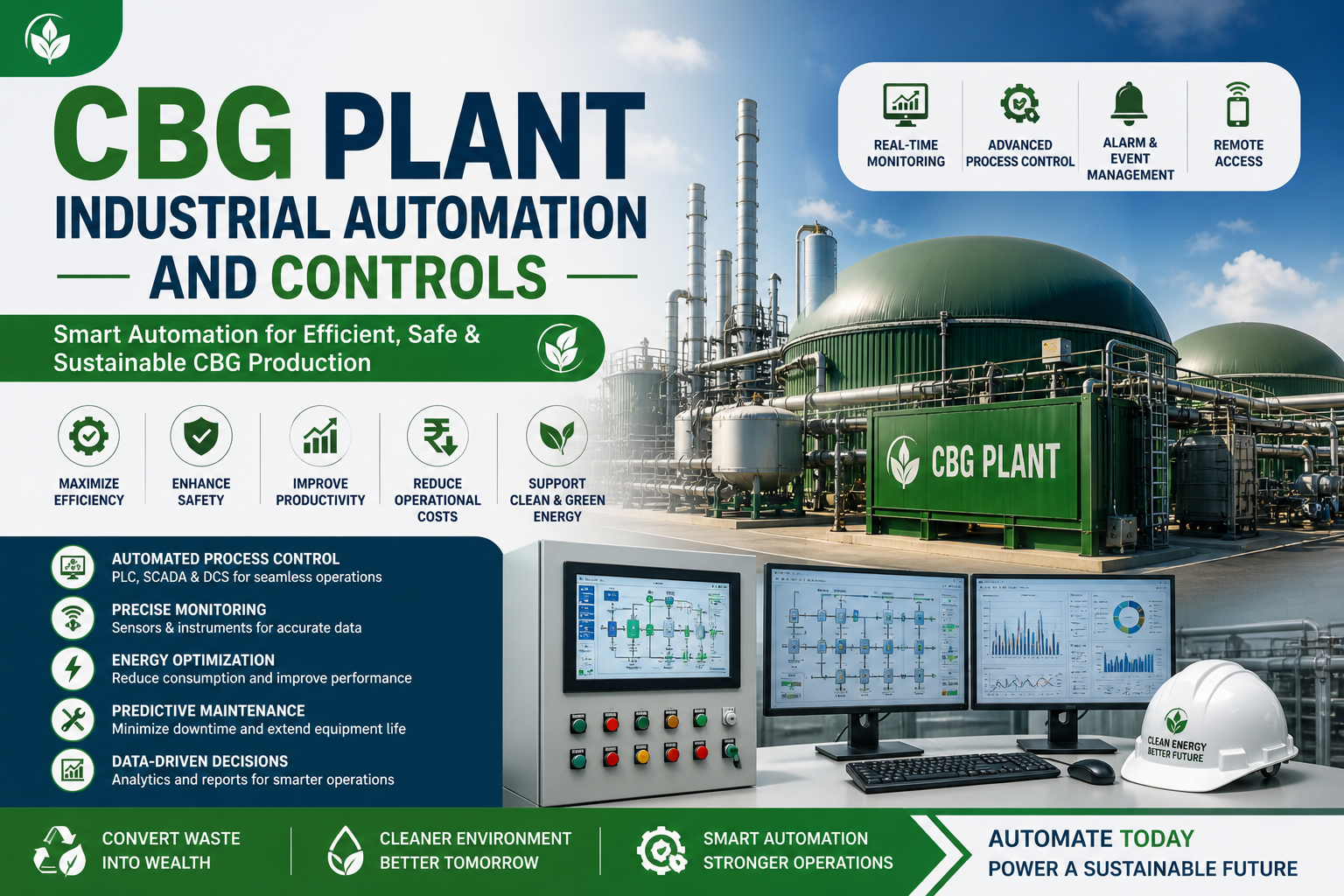
CBG Plant Industrial Automation and Controls

Compressed Biogas (CBG) is becoming one of the most important renewable energy sources in India. As industries and governments focus on sustainable energy solutions, CBG plants are playing a major role in converting agricultural waste, municipal waste, and organic materials into clean fuel.
However, operating a CBG plant efficiently is a complex process. It involves gas generation, purification, compression, storage, and distribution. Managing these operations manually can lead to inefficiencies, safety risks, and production losses.
This is why modern industries are investing in CBG plant industrial automation and controls. Automation technologies help plants operate safely, efficiently, and with better productivity while reducing operational costs.
In this blog, we will explore the importance of automation in CBG plants, key control technologies, benefits, and best practices for modern industrial operations.
What Is a CBG Plant?
A CBG plant converts organic waste into biogas through anaerobic digestion. The biogas is then purified and compressed into Compressed Biogas (CBG), which can be used as an alternative fuel for vehicles, industries, and power generation.
Common raw materials used in CBG plants include:
- Agricultural residue
- Food waste
- Animal waste
- Municipal organic waste
- Sewage sludge
The final product, CBG, is environmentally friendly and supports India’s clean energy goals.
Why Automation Is Important in CBG Plants
CBG production involves multiple stages that require accurate monitoring and control. Variations in temperature, pressure, gas composition, and feedstock quality can directly affect gas production efficiency.
Manual operations often lead to:
- Inconsistent production
- Energy losses
- Human errors
- Equipment damage
- Safety hazards
This is where CBG plant industrial automation and controls become essential.
Automation systems help:
- Maintain process stability
- Improve gas yield
- Reduce downtime
- Ensure plant safety
- Optimize energy consumption
Key Components of CBG Plant Industrial Automation and Controls
Modern CBG plants use a combination of automation technologies to manage operations efficiently.
- PLC (Programmable Logic Controller)
PLCs are one of the most important components of industrial automation systems.
In CBG plants, PLCs control:
- Feedstock handling systems
- Mixing systems
- Pumps and motors
- Digesters
- Compressors
- Gas purification systems
PLCs execute real-time control operations with high accuracy and reliability.
Benefits of PLC Systems
- Fast response time
- Flexible programming
- Reliable operation
- Reduced manual intervention
- Easy troubleshooting
PLCs form the foundation of efficient CBG plant industrial automation and controls.
- SCADA Systems
SCADA (Supervisory Control and Data Acquisition) systems provide centralized monitoring and control.
SCADA systems allow operators to:
- Monitor plant performance in real time
- View process parameters on dashboards
- Receive alarms and notifications
- Analyze historical data
- Generate reports
A SCADA system improves operational transparency and enables better decision-making.
- Sensors and Instrumentation
Sensors are critical for collecting process data throughout the plant.
Common sensors used in CBG plants include:
- Temperature sensors
- Pressure transmitters
- Flow meters
- Gas analyzers
- Level sensors
- Moisture analyzers
These instruments provide accurate data for process optimization and safety management.
- Gas Monitoring Systems
Gas quality monitoring is extremely important in CBG plants.
Automation systems continuously monitor:
- Methane concentration
- Carbon dioxide levels
- Oxygen presence
- Hydrogen sulfide concentration
Gas monitoring systems help:
- Improve gas purity
- Prevent hazardous conditions
- Maintain safety standards
- Optimize purification processes
- DCS (Distributed Control System)
Large-scale CBG facilities often use Distributed Control Systems (DCS) for advanced process management.
DCS systems provide:
- Centralized process control
- High reliability
- Redundant operation
- Continuous monitoring
They are ideal for complex and large industrial plants requiring uninterrupted operations.
- HMI (Human Machine Interface)
HMI systems provide user-friendly interfaces for plant operators.
Operators can:
- Monitor system status
- Adjust process parameters
- Respond to alarms
- Analyze performance trends
HMIs simplify plant operations and improve productivity.
Benefits of CBG Plant Industrial Automation and Controls
Automation delivers significant operational and financial benefits for CBG plants.
- Improved Gas Production Efficiency
Automation ensures accurate control of:
- Digester temperature
- Retention time
- Feedstock feeding
- Mixing operations
Optimized process conditions increase methane yield and improve overall plant efficiency.
- Enhanced Safety
CBG plants handle flammable gases and pressurized systems.
Automation improves safety through:
- Leak detection systems
- Pressure monitoring
- Emergency shutdown systems
- Alarm management
These systems reduce the risk of accidents and ensure safe operations.
- Reduced Operational Costs
Automation minimizes:
- Manual labor requirements
- Energy wastage
- Equipment failures
- Maintenance expenses
Predictive maintenance systems help identify issues before they cause major breakdowns.
- Real-Time Monitoring and Remote Access
Modern automation systems allow remote monitoring of plant operations.
Plant managers can:
- Monitor performance remotely
- Receive alerts on mobile devices
- Access reports from anywhere
This improves operational flexibility and faster decision-making.
- Better Compliance and Reporting
CBG plants must comply with environmental and industrial safety regulations.
Automation systems automatically generate:
- Production reports
- Emission records
- Safety logs
- Operational analytics
This simplifies compliance management.
Industrial IoT and Smart CBG Plants
Industry 4.0 technologies are transforming renewable energy operations.
Smart CBG plants use:
- Industrial IoT (IIoT)
- Cloud-based monitoring
- AI-driven analytics
- Predictive maintenance systems
These technologies improve plant intelligence and operational efficiency.
Predictive Maintenance in CBG Plants
Unexpected equipment failures can disrupt gas production and increase costs.
Predictive maintenance systems monitor:
- Vibration levels
- Motor temperature
- Compressor performance
- Pump efficiency
Analytics tools predict failures before they happen, reducing downtime and repair costs.
Energy Management in CBG Plants
Energy optimization is important for profitability.
Automation systems help:
- Monitor power consumption
- Optimize compressor operations
- Improve heating efficiency
- Reduce energy losses
Efficient energy management improves sustainability and operational savings.
Challenges in Implementing Automation
Although automation offers many benefits, industries may face certain challenges:
- High initial investment
- Integration with existing systems
- Requirement for skilled operators
- Maintenance of advanced technologies
However, the long-term benefits usually outweigh these challenges.
Best Practices for CBG Plant Automation
To achieve maximum efficiency, plants should follow these best practices:
- Choose Scalable Systems
Automation architecture should support future plant expansion.
- Use High-Quality Instrumentation
Reliable sensors and analyzers improve accuracy and process stability.
- Focus on Cybersecurity
Connected systems must be protected from cyber threats through secure networks and access control.
- Implement Predictive Analytics
AI and analytics tools improve decision-making and maintenance planning.
- Train Plant Operators
Skilled operators ensure proper use of automation systems and better plant performance.
Future of CBG Plant Industrial Automation and Controls
India’s renewable energy sector is growing rapidly, and CBG production is expected to expand significantly in the coming years.
Future trends include:
- AI-powered process optimization
- Fully automated smart plants
- Digital twin technology
- Advanced remote monitoring systems
- Cloud-integrated control platforms
Automation will become even more important for achieving efficient and sustainable CBG production.
Role of Automation Companies in CBG Projects
Professional automation companies provide:
- System design and engineering
- PLC and SCADA programming
- Instrumentation integration
- Installation and commissioning
- Maintenance and technical support
Partnering with an experienced automation provider ensures reliable plant performance and long-term success.
Conclusion
CBG plants are becoming a key part of India’s sustainable energy future. However, efficient production and safe operations require advanced technology and intelligent process control.
CBG plant industrial automation and controls help industries improve gas production efficiency, reduce operational costs, enhance safety, and achieve better process reliability.
By adopting modern automation technologies such as PLC, SCADA, DCS, IIoT, and predictive analytics, industries can transform traditional CBG facilities into smart, efficient, and future-ready renewable energy plants.
As India continues to invest in clean energy, automation will remain one of the most important drivers of growth and sustainability in the CBG sector.