
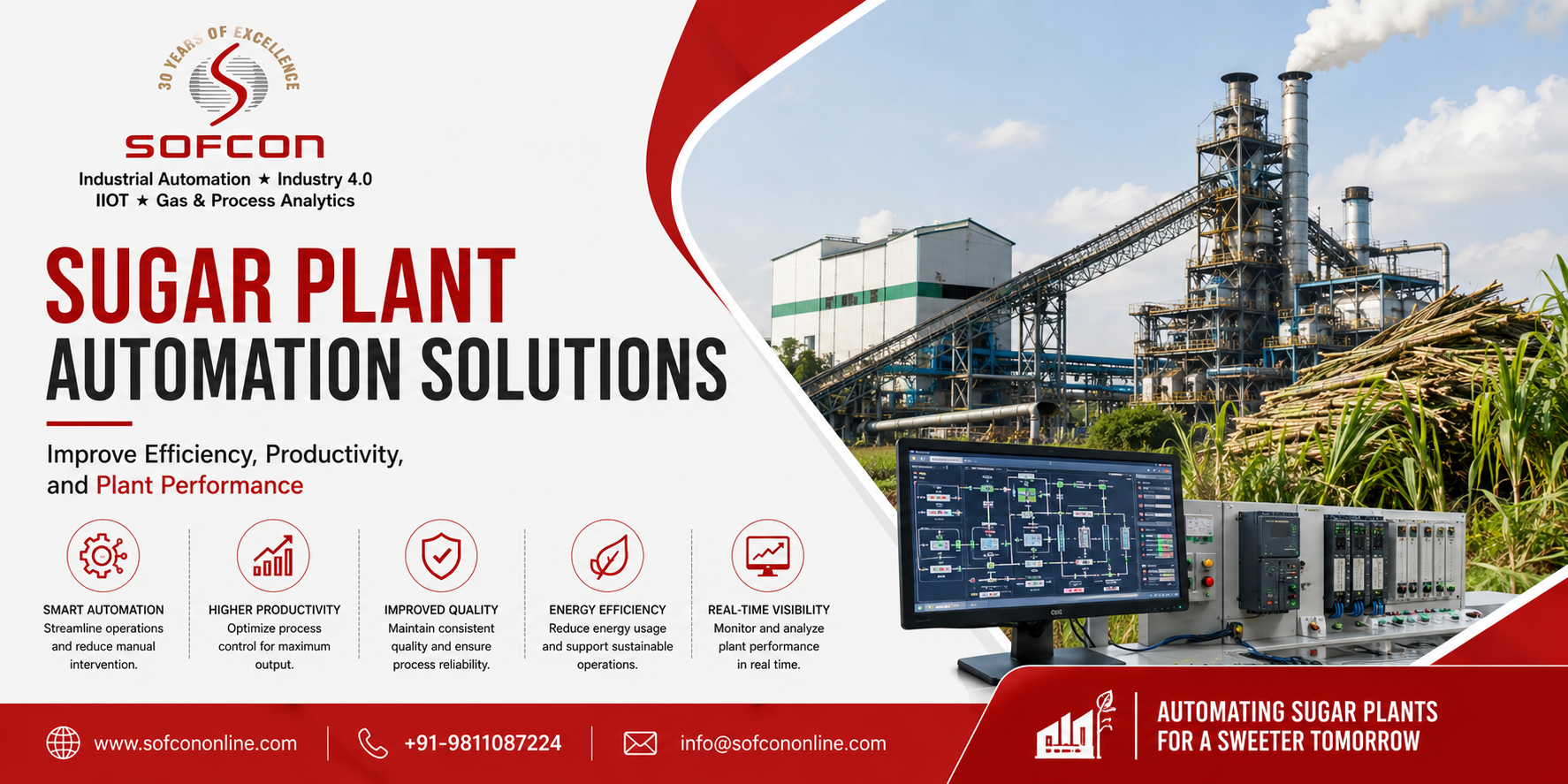
Sugar Plant Automation Solutions: Improve Efficiency, Productivity, and Plant Performance
Sugar Plant Automation Solutions: Improve Efficiency, Productivity, and Plant Performance
Sugar manufacturing is a continuous process where many machines and processes work together. From cane handling and crushing to juice clarification, evaporation, crystallisation, centrifuging and sugar packing, every stage needs proper control.
Even a small change in temperature, pressure, flow, level or machine speed can affect production and sugar quality.
This is why Sugar Plant Automation Solutions are becoming important for modern sugar mills. Automation helps operators monitor plant processes, control machines and collect production data from one place.
A properly designed automation system can help sugar plants improve efficiency, reduce downtime, maintain product quality and get better performance from machines.
What Are Sugar Plant Automation Solutions?
Sugar plant automation solutions are industrial control systems used to monitor and control different operations in a sugar manufacturing plant.
These solutions can include PLC systems, SCADA systems, DCS systems, HMIs, industrial drives, sensors, control panels, industrial networks and production monitoring software.
The automation system receives information from field instruments and machines. It processes this information and sends control commands to different equipment.
For example, the system can monitor:
- Temperature
- Pressure
- Flow
- Level
- Motor current
- Machine speed
- Steam pressure
- Juice flow
- Water flow
- Energy consumption
- Production data
Operators can view this information from a central control room and take action when required.
Why Automation Is Important in Sugar Plants
A sugar plant has many processes that depend on each other.
Cane needs to reach the crushing section at the right rate. Juice needs proper treatment before further processing. Steam and heat need to be controlled during evaporation. Crystallisation needs stable process conditions.
Manual control of all these operations can be difficult, especially in large plants.
Automation helps by continuously monitoring important process parameters and controlling equipment according to programmed conditions.
This allows the plant to maintain more stable operations.
How Automation Improves Sugar Plant Efficiency
Efficiency is an important target for every sugar mill. Better efficiency means using raw materials, energy, machines and manpower in a better way.
Automation can support this in several ways.
- Better Process Control
Automation allows operators to maintain important process parameters within required limits.
Sensors continuously send process information to PLC or DCS systems.
The control system can then make changes based on programmed logic.
For example, valves can be adjusted according to flow requirements. Pumps can be controlled based on tank levels. Motors can run at suitable speeds using variable frequency drives.
This helps reduce unnecessary manual adjustments.
- Faster Response
Process conditions can change quickly in a sugar plant.
If a pressure or temperature value changes, the automation system can detect it immediately.
An alarm can alert the operator and the control system can take an automatic action where suitable.
This helps reduce the effect of process problems.
- Better Machine Utilisation
Automation provides information about machine operating conditions.
Operators can monitor motor status, machine speed, running hours and other important values.
This helps the production and maintenance teams understand how equipment is performing.
Automation in Cane Handling
Cane handling is the first major stage in many sugar plants.
Cane needs to be transported from the unloading area to the preparation and crushing section.
Automation can control conveyors, feeders, motors and related equipment.
Sensors can help monitor:
- Conveyor movement
- Motor status
- Material flow
- Equipment condition
- Speed
- Emergency conditions
Interlocking can also be used to control equipment in the correct sequence.
For example, if a downstream conveyor stops, the related upstream equipment can be stopped according to the programmed logic.
This can help prevent unnecessary material accumulation.
Automation in Cane Preparation and Crushing
The crushing section is one of the most important areas of a sugar mill.
Its main purpose is to extract juice from sugarcane.
The performance of the crushing section can affect the overall plant output.
Automation can help control and monitor:
- Mill speed
- Motor load
- Hydraulic pressure
- Juice flow
- Imbibition water
- Equipment status
- Conveyor speed
Continuous monitoring allows operators to understand the operating condition of the crushing system.
If motor load or another important parameter changes unexpectedly, the system can generate an alarm.
Juice Flow Monitoring
Juice flow is an important parameter in sugar manufacturing.
Flow meters and other instruments can provide information about the quantity of juice moving through different process sections.
Automation can collect this information and display it to operators.
This helps the production team understand the current process condition and make suitable adjustments.
Automation in Juice Clarification
After extraction, the juice goes through treatment and clarification processes.
Temperature, pH, flow and chemical dosing can affect the process.
Automation can help monitor these parameters and control related equipment.
For example, chemical dosing can be controlled according to the process requirement.
Automatic control can help reduce variation caused by manual operation.
Automatic Chemical Dosing
Chemical dosing is an important part of several sugar plant processes.
Incorrect dosing can affect process performance and product quality.
Automation can connect dosing pumps with process measurements.
The system can adjust dosing according to predefined process conditions.
This can help maintain more consistent dosing and reduce unnecessary chemical use.
Automation in Evaporation
Evaporation is used to remove water from clarified juice and increase its concentration.
The process involves steam, temperature, pressure, juice flow and other parameters.
Automation can monitor these values continuously.
A control system can manage valves, pumps and other equipment according to the process requirements.
Better control of evaporation can help maintain stable operating conditions and support efficient steam usage.
Steam and Boiler Automation
Steam is an important energy source in a sugar plant.
Boilers and steam systems need proper control to maintain safe and stable operation.
Automation can monitor:
- Steam pressure
- Steam temperature
- Water level
- Fuel flow
- Air flow
- Boiler load
- Feed water flow
Boiler automation can also provide alarms when operating conditions move outside the required range.
Proper control can help improve boiler performance and support better energy management.
Automation in Crystallisation
Crystallisation is an important stage in sugar production.
The process needs suitable temperature, vacuum, pressure and concentration conditions.
Automation helps operators monitor these parameters continuously.
The system can also control valves, pumps and related equipment according to the process logic.
Stable process conditions can help improve consistency in sugar production.
Automation in Centrifugal Machines
Centrifugals are used to separate sugar crystals from molasses.
These machines operate at high speeds and require proper control.
Automation can monitor machine speed, operating sequence and other important parameters.
Automatic sequencing can help ensure that different steps take place in the correct order.
This can reduce manual intervention and improve machine operation.
Automation in Sugar Drying and Packing
After separation, sugar may need drying, cooling, grading and packing.
Automation can control conveyors, dryers, fans, packing machines and other equipment.
The system can monitor production speed and machine status.
Automatic packing systems can also help maintain a consistent packing process and reduce manual handling.
Role of PLC in Sugar Plant Automation
PLC stands for Programmable Logic Controller.
PLCs are widely used for industrial machine and process control.
In a sugar plant, PLCs can control:
- Motors
- Pumps
- Conveyors
- Valves
- Dosing systems
- Centrifugals
- Fans
- Compressors
- Machine sequences
- Interlocks
The PLC receives signals from sensors and field instruments.
It processes these signals according to the programmed logic and sends commands to the connected equipment.
Role of SCADA in Sugar Plant Automation
SCADA stands for Supervisory Control and Data Acquisition.
A SCADA system provides a central interface for monitoring and controlling plant processes.
Operators can view information from different sections on screens.
A SCADA system can display:
- Plant equipment status
- Temperature
- Pressure
- Flow
- Level
- Motor status
- Alarms
- Trends
- Production information
- Historical data
This gives operators better visibility of plant operations.
Role of DCS in Large Sugar Plants
Distributed Control Systems can be used for large and continuous processes.
A DCS can control multiple process areas from a central control environment.
It can help manage process parameters, alarms, trends and production information.
The selection of PLC, SCADA or DCS depends on the size of the plant, process requirements, existing systems and future plans.
How Automation Reduces Plant Downtime
Unexpected downtime can result in production losses.
Automation can help reduce downtime by providing early information about abnormal machine conditions.
For example, the system can monitor:
- Motor current
- Temperature
- Pressure
- Vibration
- Speed
- Running hours
When a value moves outside the set range, the system can generate an alarm.
Maintenance teams can check the equipment and take action before the problem becomes more serious.
Predictive Maintenance in Sugar Plants
Traditional maintenance is often based on fixed schedules.
Modern automation systems can provide machine data that can be used for condition monitoring.
When this data is combined with suitable analytics, sugar plants can move towards a Predictive Maintenance in Manufacturing approach.
For example, increasing motor current or temperature may indicate a developing problem.
Finding such changes early can help maintenance teams plan inspection or repair work.
This can reduce the risk of unexpected equipment failure.
Energy Management Through Automation
Sugar manufacturing uses large amounts of energy in different forms.
Electricity and steam are used across many sections of the plant.
Automation can help monitor energy consumption from different equipment and process areas.
The plant can track:
- Motor energy consumption
- Boiler performance
- Steam usage
- Pump energy
- Fan energy
- Compressor energy
- Overall plant consumption
This information can help identify areas where energy use is higher than expected.
Automation Helps Reduce Production Losses
Production losses can happen because of machine problems, process variation, poor control or downtime.
Automation provides better information about where losses may be occurring.
For example, production data can be compared with machine running time and process conditions.
This helps the production team identify areas that need attention.
OEE Monitoring in Sugar Plants
OEE stands for Overall Equipment Effectiveness.
It is used to understand how effectively equipment is being used.
OEE is generally based on:
- Availability
- Performance
- Quality
Automation systems can collect data needed for OEE calculations.
For example, machine running time can support availability calculations. Production speed can help measure performance. Quality information can support the quality calculation.
With OEE Monitoring, sugar manufacturers can identify production losses and understand machine performance more clearly.
Real Time Production Monitoring
Real time monitoring helps operators know what is happening inside the plant.
Instead of depending only on manual records, production teams can view live information from connected machines and instruments.
A central dashboard can show:
- Production rate
- Machine status
- Downtime
- Process values
- Energy consumption
- Alarms
- Equipment performance
This helps operators respond faster to production issues.
Industrial IoT in Sugar Plant Automation
Industrial IoT can connect machines, sensors and software systems.
A sugar plant can collect machine and process data and send it to a central platform for monitoring and analysis.
This can support:
- Remote monitoring
- Machine condition monitoring
- Production reporting
- Energy monitoring
- Maintenance analysis
- Performance tracking
Industrial IoT in Manufacturing can work along with existing PLC, SCADA and other automation systems.
Data Logging and Reporting
Automation systems can store production and process data.
This data can be used for daily and monthly reports.
For example, the plant can track:
- Production output
- Machine downtime
- Energy consumption
- Alarm history
- Equipment running hours
- Process trends
- Production losses
Historical information can help managers compare plant performance over different periods.
Better Plant Safety
Sugar plants have many machines, rotating equipment, high pressure systems and high temperature processes.
Automation can support plant safety by using alarms, interlocks and suitable safety control systems.
For example, equipment can be prevented from starting when certain operating conditions are not met.
Emergency stop systems and safety controls can also be used according to the plant’s safety requirements.
Automation should work along with proper safety procedures, training and regular equipment inspection.
Centralised Control Room
A large sugar plant may have many production sections spread across the facility.
A central control room can bring information from different areas together.
Operators can monitor the plant through SCADA or DCS screens.
This makes it easier to understand the overall plant condition and respond to process problems.
Benefits of Sugar Plant Automation Solutions
A properly designed automation system can provide several benefits.
Improved Efficiency
Better control of machines and processes can reduce unnecessary operation and process variation.
Higher Productivity
Automation can reduce manual work and support better machine utilisation.
Better Sugar Quality
Stable process conditions can help maintain consistent production.
Reduced Downtime
Alarms and machine monitoring can help identify problems earlier.
Better Energy Management
Energy data helps the plant understand where electricity and steam are being used.
Reduced Waste
Better process control can help reduce material and production losses.
Better Data
Production and machine data can be collected automatically and used for reports and analysis.
Improved Operator Control
Operators get a central view of plant conditions and can respond faster.
How to Choose the Right Sugar Plant Automation Company
The right automation partner should understand both industrial automation and the requirements of sugar manufacturing.
Before selecting a company, check its experience in:
- PLC programming
- SCADA systems
- DCS systems
- HMI development
- Control panels
- Industrial drives
- Instrumentation
- Industrial networking
- Machine automation
- Process automation
- Data monitoring
- System integration
The automation company should first understand the existing plant.
It should review the current machines, control systems, field instruments and production requirements before suggesting a solution.
Important Points Before Automation Implementation
Automation should be planned properly before installation.
Study the Existing Plant
The automation team should understand the current process and equipment.
Define the Required Parameters
Decide which temperature, pressure, flow, level and machine parameters need monitoring.
Plan the Control System
Select the right PLC, SCADA or DCS architecture based on the process.
Plan Industrial Networking
Communication between PLCs, instruments, drives and monitoring systems should be properly planned.
Train Operators
Operators should be trained to use the system and understand alarms and process screens.
Plan Maintenance
Regular system maintenance should be included from the beginning.
Future of Sugar Plant Automation
Sugar plants are moving towards more connected and data based production systems.
Modern automation is not limited to controlling machines. It can also help plants collect and analyse production data.
Technologies such as Industrial IoT, advanced analytics, condition monitoring and energy monitoring can work with traditional automation systems.
The future focus will be on better production visibility, lower downtime, improved energy use and more reliable equipment performance.
However, the basic automation system must still be reliable and easy for plant operators and maintenance teams to use.
Conclusion
Sugar manufacturing involves many connected processes. Efficient operation requires proper control of machines, process parameters, energy and production flow.
Sugar Plant Automation Solutions help manufacturers monitor and control these processes through PLC, SCADA, DCS, HMI, sensors, drives and industrial communication systems.
Automation can help improve plant efficiency, productivity and sugar quality while reducing downtime, waste and unnecessary energy use.
For sugar manufacturers planning plant modernisation, the right automation solution should be based on the actual process, existing equipment and future production requirements.
With proper planning and implementation, automation can help a sugar plant achieve better control, better production visibility and improved overall plant performance.