
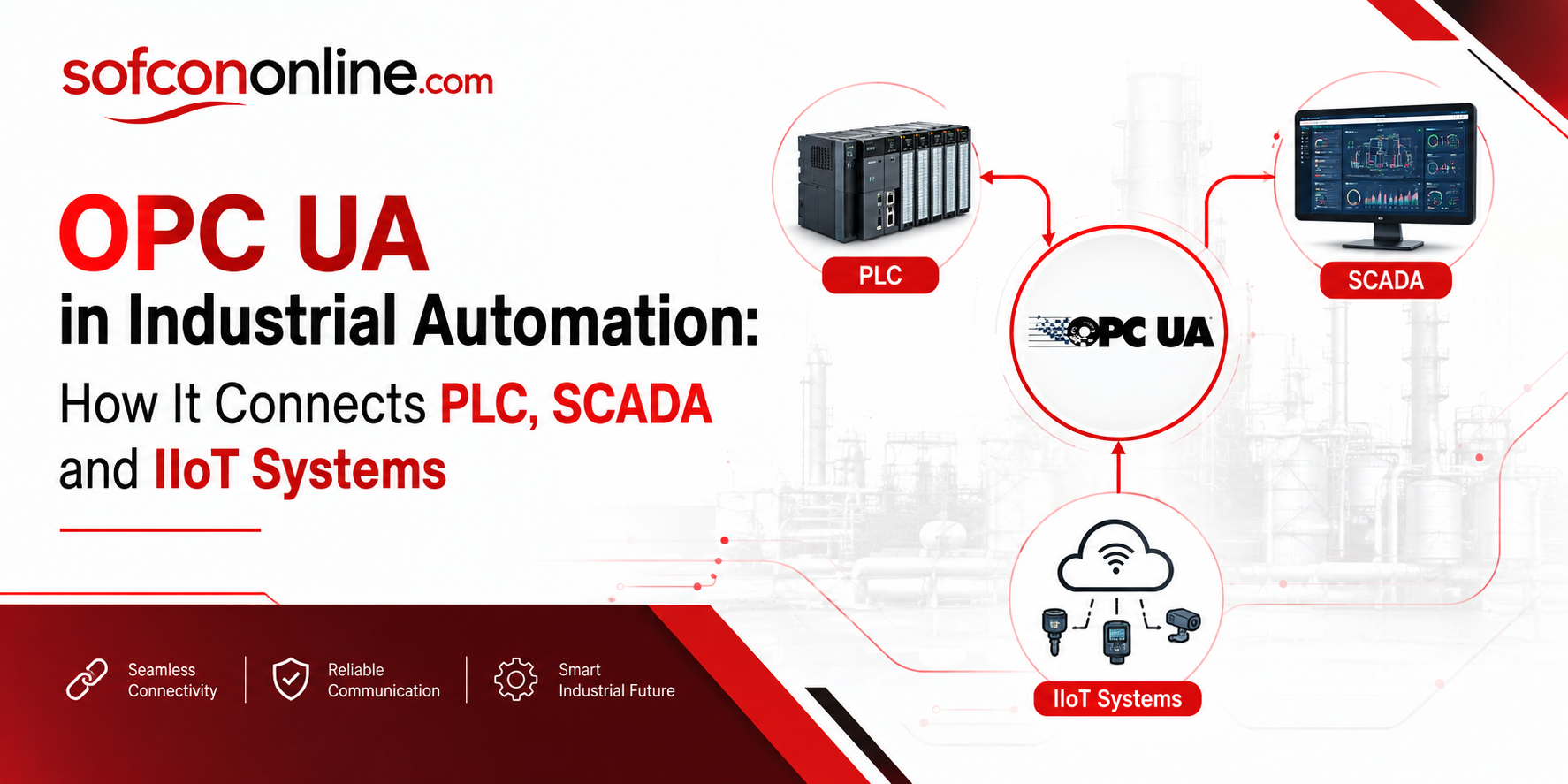
OPC UA in Industrial Automation: How It Connects PLC SCADA and IIoT Systems
Modern factories use many different machines and automation systems. PLCs control machines. SCADA systems monitor industrial processes. Sensors collect field data. IIoT systems collect production information and help companies use this data for better monitoring and analysis.
The main challenge is making these different systems communicate with each other.
This is where OPC UA can be useful.
OPC UA is a communication technology used in industrial automation to exchange data between different devices and software systems. It can help connect PLCs, SCADA systems, industrial applications and IIoT platforms.
For manufacturers moving towards Industry 4.0, OPC UA can help create better communication between machines and higher level systems.
What Is OPC UA?
OPC UA stands for Open Platform Communications Unified Architecture.
It is an industrial communication standard used to exchange information between machines, devices and software applications.
In a factory, different equipment may come from different manufacturers. Each system may use its own communication method.
OPC UA provides a common way for these systems to share industrial data.
For example, a PLC may collect machine data while a SCADA system needs to display it. An IIoT platform may also need the same data for monitoring and analysis.
OPC UA can help move this data between the required systems.
Why Communication Is Important in Industrial Automation
A modern manufacturing plant may have hundreds of data points.
These can include:
- Machine running status
- Temperature
- Pressure
- Production count
- Motor speed
- Energy consumption
- Alarm status
- Production cycle time
- Machine downtime
- Process values
If this information remains inside individual machines, it is difficult for managers and other systems to use it.
Industrial communication allows this data to move from the machine level to monitoring and business applications.
This creates better visibility across the plant.
How OPC UA Works
OPC UA uses a client and server based communication model.
An OPC UA server provides access to industrial data.
An OPC UA client connects to the server and requests the required information.
For example, a PLC or automation device may provide machine information through an OPC UA server. A SCADA system can connect as a client and read this data.
Similarly, an IIoT application can connect to the required data and use it for monitoring or analysis.
The exact setup depends on the automation architecture and the equipment being used.
OPC UA and PLC
PLC systems are used for controlling machines and industrial processes.
A PLC receives information from sensors and other devices and controls outputs based on the programmed logic.
The same PLC data may also be useful for monitoring and analysis.
For example, a PLC may have information about:
- Motor status
- Production counter
- Temperature
- Pressure
- Machine alarms
- Cycle time
- Machine speed
OPC UA can provide a communication layer through which this information can be shared with other industrial systems.
This means the production data does not have to remain limited to the PLC.
OPC UA and SCADA
SCADA systems are used for monitoring and controlling industrial processes.
A SCADA system may collect information from multiple PLCs and display it to operators.
OPC UA can help connect SCADA software with industrial devices and applications.
For example, an OPC UA connection can provide machine data to a SCADA application.
The SCADA system can then display the information through screens, trends, alarms and reports.
This can help operators understand what is happening on the production floor.
OPC UA and IIoT
Industrial IoT requires data from machines and industrial equipment.
An IIoT platform can use machine data for monitoring, reporting and analysis.
OPC UA can help provide this data from industrial systems.
For example, a factory can collect PLC data through OPC UA and send selected information to an IIoT platform.
The IIoT platform can then use the data for:
- Machine monitoring
- Production monitoring
- OEE monitoring
- Energy monitoring
- Asset monitoring
- Performance analysis
- Remote monitoring
This can help connect existing automation systems with newer digital solutions.
OPC UA and Industry 4.0
Industry 4.0 focuses on connected machines, data and smarter manufacturing processes.
For this to work, industrial systems need to communicate properly.
OPC UA can support this communication by providing a common method for exchanging data.
A typical Industry 4.0 setup may include:
Sensors → PLC → OPC UA → SCADA or IIoT Platform → Dashboard
The actual architecture can be different depending on the factory.
The main idea is to make useful machine data available to the systems that need it.
OPC UA for Legacy Automation Systems
Many factories have automation systems that were installed years ago.
Replacing all old machines and PLCs can be expensive and may not always be required.
In some cases, existing systems can be connected with newer monitoring and IIoT solutions using suitable communication methods.
OPC UA can be part of this integration approach.
However, the actual solution depends on the PLC model, controller capabilities, available communication protocols and existing network structure.
A proper automation assessment should be done before selecting the communication method.
OPC UA for Multiple PLC Systems
A manufacturing plant may use PLCs from different manufacturers.
For example, one production line may use one PLC brand while another line uses a different brand.
This can create communication challenges.
OPC UA can help provide a common communication layer where supported by the devices or through suitable OPC UA gateway solutions.
This can make it easier to bring data from different systems into a common monitoring platform.
OPC UA for Real Time Monitoring
Manufacturers often need real time information about their production systems.
They may want to know:
- Which machines are running
- Which machines are stopped
- Current production count
- Current process values
- Active alarms
- Machine performance
- Production losses
OPC UA can help make this information available to monitoring systems.
The monitoring system can then display the data on dashboards for operators and managers.
OPC UA and OEE Monitoring
OEE monitoring depends on production data.
Important OEE information includes machine availability, production performance and product quality.
Much of this information can come from PLC and automation systems.
OPC UA can help transfer the required machine data to an OEE monitoring application.
For example, machine running status and production counts can be collected from the PLC.
The OEE system can use this information along with other production data to calculate equipment performance.
This can reduce dependence on manual data collection.
OPC UA and Data Collection
Data collection is an important part of industrial digitalisation.
Without proper data collection, manufacturers cannot get a clear view of machine performance.
OPC UA can help collect structured information from connected industrial systems.
The collected data can then be stored or sent to other applications based on the plant architecture.
This can support long term production analysis.
OPC UA for Energy Monitoring
Energy consumption is another area where machine data can be useful.
Manufacturers may want to monitor electricity consumption across machines, production lines or plant areas.
Energy meters and other devices can provide this information.
OPC UA can help make selected energy data available to SCADA, IIoT or energy monitoring applications when the devices support the required communication setup.
This can help companies study energy usage along with production data.
OPC UA Security
Industrial communication needs proper security.
A factory network connects important machines and control systems. Poorly planned access can create risks.
OPC UA includes security features that can be used to protect communication.
Depending on the implementation, security can include authentication, encryption and certificates.
However, using OPC UA alone does not make an entire industrial network secure.
Factories should also follow proper network security practices.
These may include:
- Network segmentation
- Access control
- User authentication
- Firewall configuration
- Secure remote access
- Regular system updates
- Monitoring of network activity
The final security setup should be designed according to the plant requirements.
OPC UA vs Traditional Industrial Communication
Traditional industrial automation systems often use different communication protocols for different devices.
These protocols may work well within their intended application but can create challenges when data needs to move between different levels of the factory.
OPC UA is designed to support communication between industrial devices and software applications.
This makes it useful when manufacturers want to connect machine level systems with SCADA, IIoT and higher level applications.
The right communication technology still depends on the actual automation system.
OPC UA is not a replacement for every industrial protocol.
Benefits of OPC UA in Industrial Automation
OPC UA can provide several benefits when properly implemented.
Better Data Connectivity
It can help connect different industrial devices and applications.
Easier Data Sharing
Machine data can be shared with SCADA, IIoT and other applications.
Support for Industry 4.0
It can help connect existing automation systems with modern digital solutions.
Reduced Manual Data Collection
Production information can be collected automatically from connected systems.
Better Monitoring
Operators and managers can get better visibility into machine and process data.
Support for Different Industrial Systems
It can help create communication between systems from different manufacturers where compatible solutions are available.
Challenges of OPC UA Implementation
OPC UA can be useful but implementation needs proper planning.
The first step is understanding the existing automation system.
The engineering team needs to check:
- PLC models
- Communication capabilities
- SCADA system
- Network architecture
- Existing protocols
- Data points required
- Cybersecurity requirements
- IIoT platform requirements
Another important point is data selection.
A factory may have thousands of available data points. Sending all of them may not be necessary.
It is better to identify the data that is actually required for monitoring, production analysis and other applications.
How to Implement OPC UA in a Manufacturing Plant
A practical OPC UA implementation can start with a clear assessment of the existing plant.
Step 1: Study the Existing Automation System
Identify PLCs, SCADA systems, sensors, machines and industrial networks.
Step 2: Identify Required Data
Decide which machine and production data needs to be shared.
Step 3: Check Communication Support
Check whether existing devices directly support OPC UA or require a suitable gateway or communication layer.
Step 4: Design the Network
Plan how the devices, OPC UA servers, clients and monitoring systems will communicate.
Step 5: Configure Data Access
Set up the required data points and communication settings.
Step 6: Add Monitoring Applications
Connect SCADA, OEE, IIoT or other applications based on the project requirement.
Step 7: Test the System
Check data accuracy, communication reliability and system performance.
Step 8: Secure the Communication
Apply proper authentication, certificates, access control and network security measures.
OPC UA and Smart Factory Development
A smart factory needs connected machines and useful production data.
OPC UA can be one part of this connected factory architecture.
For example:
Machine Sensors
↓
PLC
↓
OPC UA Communication
↓
SCADA / IIoT Platform
↓
Production Dashboard
↓
Management Reports
This type of architecture can help manufacturers move from isolated machine systems towards connected production monitoring.
Why OPC UA Matters for Modern Manufacturing
Factories are generating more data than ever before.
The challenge is not only collecting data. The data also needs to reach the right systems in a useful format.
OPC UA can help create a communication link between industrial equipment and software applications.
It can support applications such as SCADA monitoring, OEE monitoring, IIoT, production dashboards and industrial data analysis.
For manufacturers planning Industry 4.0 projects, OPC UA can be considered as part of the overall communication architecture.
Conclusion
OPC UA is an important communication technology for modern industrial automation.
It can help connect PLCs, SCADA systems, IIoT platforms and other industrial applications. By making machine data available to different systems, it can support better production monitoring and data based decision making.
OPC UA can also be useful when manufacturers want to connect existing automation systems with newer Industry 4.0 and IIoT solutions.
However, every factory has a different automation setup. The right OPC UA architecture depends on the machines, PLCs, communication protocols, network design and business requirements.
A proper assessment of the existing automation system should be done before implementing an OPC UA based solution.
Sofcon works in industrial automation, SCADA, PLC, Industry 4.0 and IIoT solutions. Its Industry 4.0 and IIoT solutions include real time asset monitoring, OEE and TEEP monitoring, remote access, network monitoring and cloud and edge based solutions. OPC UA based connectivity can be considered as part of such industrial data integration projects depending on the existing plant architecture and project requirements.