
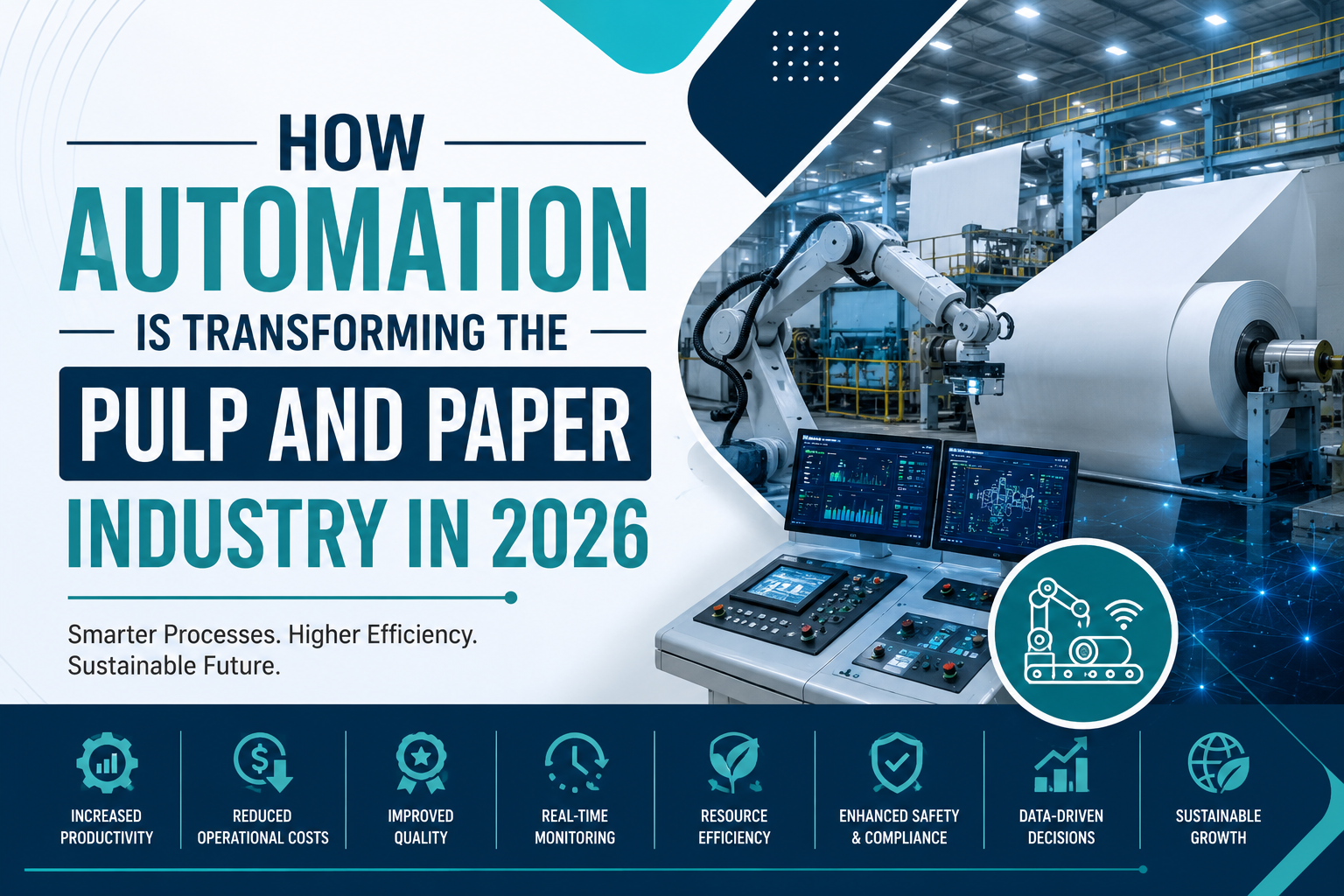
How Automation is Transforming the Pulp and Paper Industry in 2026

The pulp and paper industry has always been one of the most important sectors for manufacturing and packaging worldwide. From newspapers and notebooks to packaging boxes and tissue products, paper products are used every day in homes and industries. In 2026, this industry is going through a major transformation with the help of industrial automation technologies.
Today, paper mills are adopting smart systems, advanced sensors, PLCs, SCADA systems, DCS platforms, and AI-based monitoring solutions to improve production quality and reduce operational costs. Automation is helping companies achieve higher productivity, better energy efficiency, and improved safety standards.
Modern factories now depend heavily on a reliable Control & Automation Solution for Pulp and Paper Industry to stay competitive in the market. Automation not only increases efficiency but also minimizes downtime, reduces waste, and improves overall plant performance.
In this blog, we will explore how automation is changing the pulp and paper industry in 2026 and why industries are investing in advanced automation solutions.
Understanding Automation in the Pulp and Paper Industry
Industrial automation refers to the use of computerized systems and intelligent machines to control industrial processes with minimal human intervention. In pulp and paper plants, automation systems monitor and control different stages such as:
- Wood preparation
- Pulp processing
- Chemical mixing
- Bleaching
- Paper forming
- Drying
- Finishing
- Packaging
Automation technologies include:
- PLC (Programmable Logic Controller)
- SCADA (Supervisory Control and Data Acquisition)
- DCS (Distributed Control System)
- HMI (Human Machine Interface)
- Industrial IoT
- AI-based predictive maintenance systems
- Smart sensors and drives
These technologies help paper manufacturers operate more efficiently and safely.
Why Automation is Important in 2026
The demand for paper products is changing rapidly due to the growth of e-commerce, sustainable packaging, and hygiene products. At the same time, industries are facing challenges such as:
- Rising energy costs
- Shortage of skilled labor
- Strict environmental regulations
- Increasing production demands
- Need for better quality control
Automation provides practical solutions to these challenges. In 2026, companies that adopt automation are able to improve their operations and maintain a strong position in the market.
Major Ways Automation is Transforming the Pulp and Paper Industry
- Improved Production Efficiency
Automation systems allow machines to work continuously with minimal interruption. Automated controls optimize production speed, monitor machine performance, and reduce manual errors.
For example:
- Automated pulp consistency control improves paper quality.
- Smart drives regulate motor speed for smooth operation.
- PLC systems manage production sequences accurately.
This results in higher productivity and reduced production losses.
- Better Quality Control
Paper manufacturing requires precise control over thickness, moisture, texture, and color. Manual monitoring often leads to inconsistencies.
Automation systems use advanced sensors and real-time monitoring tools to maintain product quality throughout the manufacturing process.
Benefits include:
- Consistent paper thickness
- Improved surface finish
- Reduced defects
- Better color accuracy
- Lower rejection rates
Modern Control & Automation Solution for Pulp and Paper Industry helps manufacturers achieve high-quality standards demanded by customers.
- Energy Efficiency and Cost Reduction
Paper mills consume large amounts of electricity, steam, and water. Energy costs are one of the biggest expenses in this industry.
Automation systems optimize energy usage by:
- Monitoring power consumption
- Controlling motor loads
- Optimizing steam pressure
- Reducing idle running
- Managing water recycling systems
Variable Frequency Drives (VFDs) and intelligent motor controls help reduce unnecessary energy usage.
As a result, industries can lower operational costs and improve profitability.
- Reduced Downtime with Predictive Maintenance
Unexpected machine breakdowns can cause major production losses. In 2026, predictive maintenance has become one of the biggest advantages of industrial automation.
Advanced automation systems continuously monitor:
- Motor vibration
- Bearing temperature
- Machine pressure
- Flow rates
- Equipment health
AI-powered systems analyze data and detect potential failures before breakdowns happen.
Benefits include:
- Reduced maintenance costs
- Fewer production stoppages
- Longer equipment life
- Better maintenance planning
This helps paper mills maintain continuous production.
- Enhanced Safety Standards
The pulp and paper industry involves heavy machinery, chemicals, and high-temperature operations. Worker safety is a major concern.
Automation improves workplace safety by:
- Reducing manual handling
- Automating dangerous operations
- Providing emergency shutdown systems
- Detecting abnormal conditions instantly
- Monitoring gas leakage and fire risks
SCADA and HMI systems provide real-time alerts and alarms to operators, helping prevent accidents.
- Real-Time Data Monitoring
Modern automation systems provide centralized monitoring of the entire plant. Operators can view all important data on a single dashboard.
This includes:
- Production status
- Machine efficiency
- Temperature readings
- Pressure values
- Energy consumption
- Maintenance alerts
Real-time monitoring allows faster decision-making and improves operational control.
Industries can identify inefficiencies quickly and take corrective action immediately.
- Improved Environmental Compliance
Environmental regulations are becoming stricter worldwide. Paper industries must reduce pollution, water usage, and carbon emissions.
Automation systems help industries meet environmental standards by:
- Optimizing chemical usage
- Reducing wastewater discharge
- Monitoring emissions
- Improving water recycling
- Reducing energy wastage
Smart automation solutions support sustainable manufacturing practices and reduce environmental impact.
Role of PLC and SCADA in Paper Industries
PLC and SCADA systems are the backbone of industrial automation.
PLC Systems
PLCs control machinery and process operations automatically. In paper plants, PLCs are used for:
- Conveyor control
- Motor operations
- Pump control
- Temperature regulation
- Process sequencing
PLCs provide reliable and fast process control.
SCADA Systems
SCADA systems collect and display real-time plant data. Operators can monitor and control the plant from a centralized control room.
SCADA benefits include:
- Live process visualization
- Alarm management
- Historical data recording
- Remote monitoring
- Better process control
Together, PLC and SCADA systems create a powerful automation infrastructure for paper manufacturing plants.
Industrial IoT in the Pulp and Paper Industry
Industrial IoT (IIoT) is becoming a major trend in 2026. IIoT connects machines, sensors, and software platforms to share real-time information.
Benefits of IIoT include:
- Remote plant monitoring
- Cloud-based analytics
- Smart maintenance planning
- Improved process optimization
- Better production forecasting
IIoT helps industries make data-driven decisions and improve operational efficiency.
AI and Machine Learning in Paper Manufacturing
Artificial Intelligence (AI) is playing an important role in modern paper plants.
AI systems can:
- Predict machine failures
- Optimize production schedules
- Improve quality control
- Analyze process trends
- Reduce raw material waste
Machine learning algorithms continuously improve production efficiency by analyzing large amounts of operational data.
AI-powered automation is expected to become even more advanced in the coming years.
Challenges in Implementing Automation
Although automation offers many advantages, industries may face some challenges during implementation.
Common challenges include:
- High initial investment
- Integration with old machinery
- Need for skilled professionals
- Cybersecurity concerns
- Training requirements
However, the long-term benefits of automation usually outweigh the initial costs.
Future of Automation in the Pulp and Paper Industry
The future of the pulp and paper industry is becoming smarter, faster, and more connected.
In the coming years, we can expect:
- More AI-powered production systems
- Fully connected smart factories
- Advanced robotics
- Cloud-based plant management
- Digital twin technology
- Greater use of renewable energy systems
Industries that invest in automation today will gain long-term advantages in productivity and profitability.
Choosing the Right Automation Partner
Selecting the right automation company is important for successful implementation.
A reliable automation partner should provide:
- Customized automation solutions
- PLC and SCADA integration
- DCS programming
- Industrial IoT solutions
- Electrical panel design
- Technical support and maintenance
An experienced provider of Control & Automation Solution for Pulp and Paper Industry can help industries improve performance, reduce downtime, and achieve better operational efficiency.
Conclusion
Automation is transforming the pulp and paper industry in 2026 by improving efficiency, reducing costs, increasing safety, and enhancing product quality. Modern technologies like PLC, SCADA, Industrial IoT, and AI are helping industries move toward smarter manufacturing systems.
As competition increases and environmental standards become stricter, automation is no longer optional. It has become a necessity for industries that want long-term growth and sustainability.
Companies investing in advanced Control & Automation Solution for Pulp and Paper Industry are gaining significant advantages in production efficiency, operational control, and overall profitability.
The future of the pulp and paper industry is digital, intelligent, and fully automated.